
Commercial Due Diligence: Which Claims Hold Up?
Commercial due diligence for deal teams: the claims it must test, the evidence that settles each, and how to state confidence and gaps before the IC.
On This Page
You are in exclusivity, or close to it. The information memorandum (IM) and the management presentation make a case: the market is growing, the target wins against named competitors, customers stay, prices hold, and the supply base can carry the plan. Commercial due diligence (CDD) is the work that tells your investment committee how much of that case is supported by evidence, how much is management's word, and what is still unknown.
This guide sets out an evidence-graded approach to commercial due diligence for lower-mid-market deals. It shows what CDD should test and how to scope it to the claims that carry the price. It also shows how to read any CDD conclusion, including one you paid for, so you can see whether it rests on documents, on public sources or on the target's own statements.
In short
- Commercial due diligence is a set of claims to test, not a market report to commission. Start from the investment case and list the statements that would each have to be true.
- For each claim, name the evidence that would settle it before anyone starts researching. If no evidence could settle it, it is an assumption, and the committee should see it labelled as one.
- Grade every source for the one statement it supports: Verified, Public evidence, Supplier-stated, Estimated, Hypothesis or Unknown.
- Keep contradictions beside the conclusion they affect. A claim that disagrees with the evidence is a finding; two sources that disagree lower confidence until explained.
- State confidence as High, Moderate or Low from rules, not mood, and never as a percentage.
- End every finding with a commercial implication and an action: proceed, test, hold or investigate.
- Scope by price impact. A small deal does not need a smaller version of everything; it needs the few claims that move the number tested properly.
What commercial due diligence is for
Financial due diligence asks whether the historical numbers are right. Legal due diligence asks what the target owns, owes and has promised. Commercial due diligence asks whether the story that explains the numbers will keep producing them: why customers buy, why they stay, why the target wins, why margins hold, and whether supply can support the plan.
Most of that story arrives as claims. "We are the number two supplier to UK foodservice." "No customer is more than 15% of revenue." "Our key partner has committed capacity for 30% growth." "We have passed through every cost increase since 2022." Each sentence carries part of the valuation. Commercial due diligence earns its fee when it turns those sentences into findings that a committee member can challenge line by line.
That is why the head-term content on commercial due diligence often disappoints a deal team. A definition of CDD and a list of topics (market, competition, customers, proposition) tells you what to look at. It does not tell you what would count as an answer, how strong the answer is, or what to do when two sources disagree.
The evidence-graded method in six steps
PhaseVane uses the same sequence on every decision. It works for a full CDD scope or for one claim.
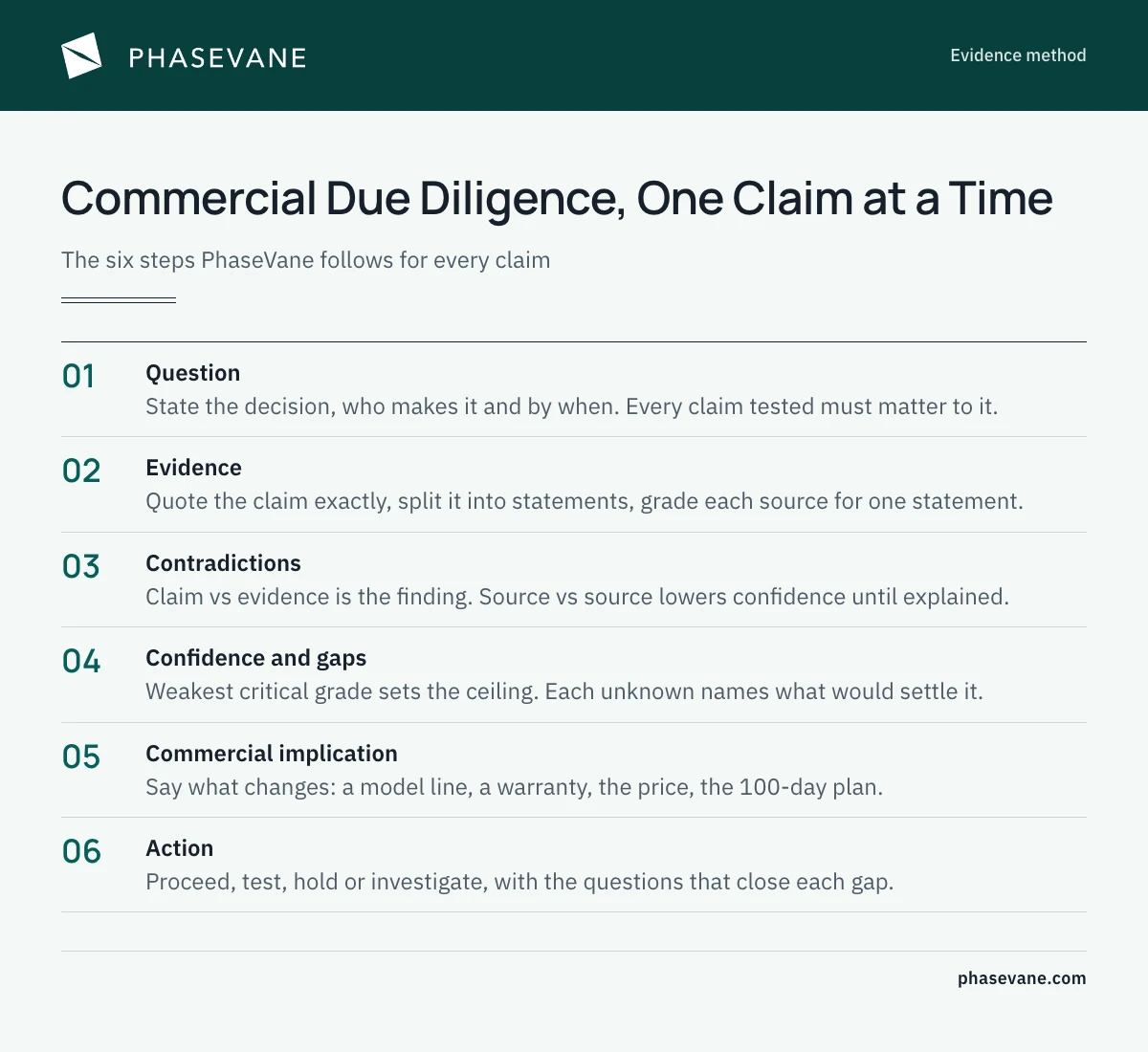 *The six steps PhaseVane follows for every claim.*
1. Question. Write the decision in one sentence, with who makes it and by when. "Should Fund B proceed from exclusivity to signing at the proposed price, given that the investment case relies on eight statements management has made about its supply base?" Every claim you test must matter to that sentence. If it does not, it is background and can wait.
2. Evidence. Quote each claim exactly, then split it into the statements that would each have to be true. "No single supplier accounts for more than 15% of purchases" contains at least two: the largest supplier account is at or below 15%, and no group of commonly owned suppliers exceeds 15%. Then read each statement against the strongest evidence you can reach, and grade each source.
3. Contradictions. When the claim and the evidence disagree, that is the finding. When two sources disagree with each other, check scope, timing, definition, metric and lineage before you choose between them. Our guide to contradictions in due diligence evidence sets out the procedure.
4. Confidence and gaps. Confidence comes from rules. The weakest critical evidence sets a ceiling, a material unknown caps it, and an open disagreement between sources lowers it. Every unknown names the document that would settle it and who holds it.
5. Commercial implication. Say what the finding changes: an assumption in the model, a warranty, a price point, an item in the 100-day plan.
6. Action. Give a position per claim: proceed, test, hold or investigate, with the management questions that would close each gap.
The six grades and the confidence they allow
A grade describes the evidence for one statement. It never describes the company, the adviser or the market.
| Grade | What it means | Highest confidence it allows on its own |
|---|---|---|
| Verified | An authoritative record supports this exact statement: an official filing, a signed contract, a customs declaration, company data reconciled to audited accounts | High |
| Public evidence | A traceable public source below that standard: directories, trade press, industry notes. Ten articles repeating one release count once | Moderate (High if independently corroborated) |
| Supplier-stated | The company, or its supplier, says it about itself: the IM, the deck, a website, an email, a data-room file that has not been reconciled | Low |
| Estimated | You calculated it from stated inputs, which you show | Moderate |
| Hypothesis | A proposition worth testing. Never written as a finding | Low |
| Unknown | The evidence does not support a conclusion. Name what would settle it | Caps the claim at Moderate if material |
Two rules do most of the work. First, the weakest critical grade sets the ceiling: if the conclusion would change were that source wrong, the conclusion cannot be stronger than that source. Second, the analyst may rate lower than the ceiling, never higher. The full reasoning, and how it adapts the UK intelligence community's published approach to analytical confidence, is in evidence grading for commercial decisions.
The UK Professional Head of Intelligence Assessment describes analytical confidence as reflecting "the soundness and stability of the foundations" on which a judgement is made, expressed as High, Moderate or Low (S1). That separation, between how likely a statement is and how much weight the reading will bear, is the part worth borrowing for deal work.
Five question families, and the evidence that settles each
Most CDD scopes cover five families of question. The useful addition is the column most scopes leave out: what evidence would answer the question, and how far that evidence can go.
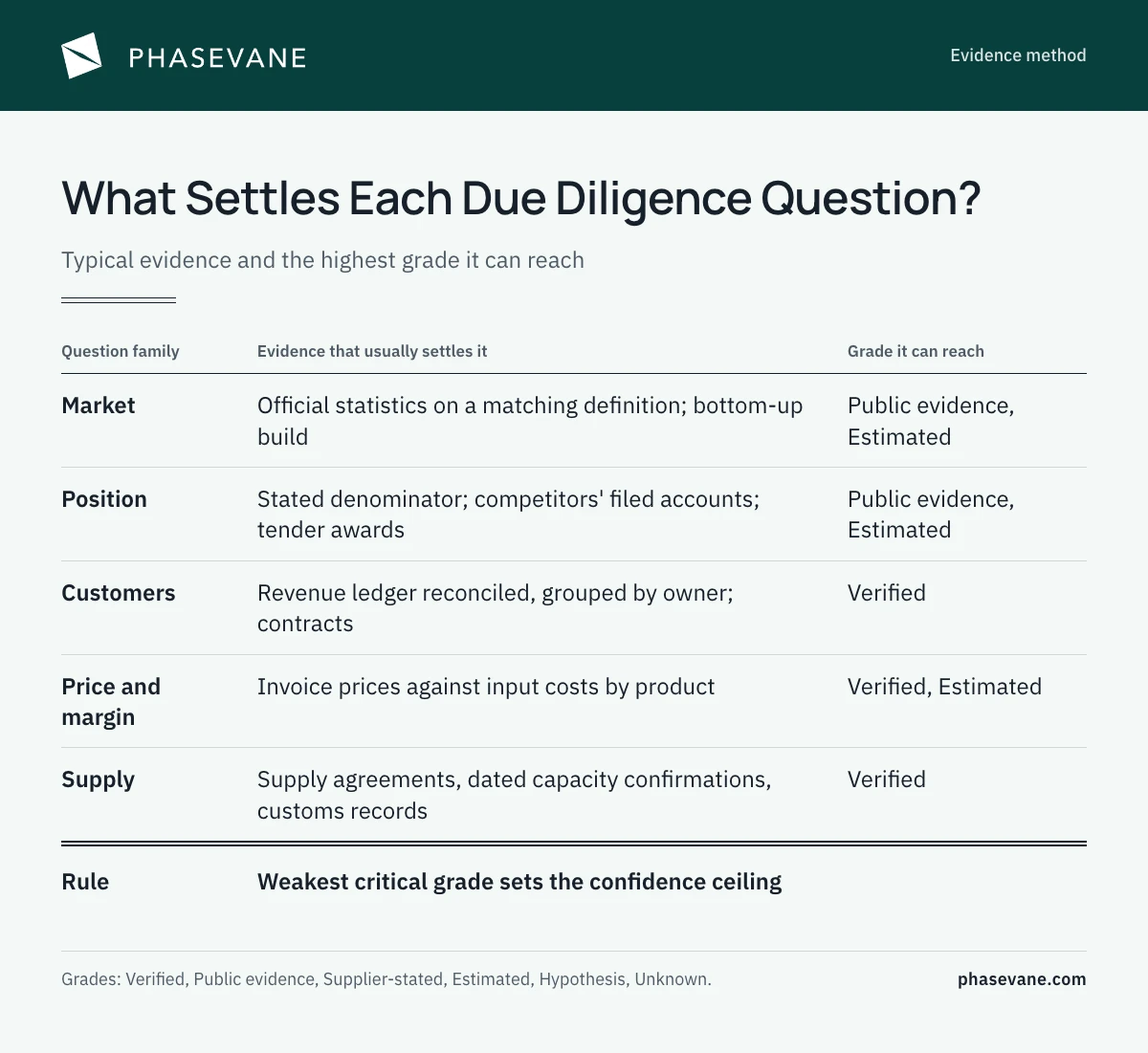 *Typical evidence and the grade it can reach for each question family.*
| Question family | Typical claim | Evidence that usually settles it | Grade it can reach |
|---|---|---|---|
| Market | "Our segment grows 8% a year" | Official statistics with a matching definition; customer purchasing data; a bottom-up build from named buyers | Public evidence, Estimated |
| Position and competition | "We are number two in UK foodservice" | A stated denominator, competitors' filed accounts, tender awards, customer share-of-wallet data | Public evidence, Estimated |
| Customers | "No customer above 15% of revenue" | Revenue ledger reconciled to audited accounts, grouped by ultimate owner; contracts; 36 months of order history | Verified |
| Price and margin | "We pass cost increases through within a quarter" | Invoice price history against input cost history by product; customer price-review terms | Verified, Estimated |
| Supply and delivery | "Capacity is secured for the plan" | Supply agreements, capacity confirmations with dates and volumes, purchase orders and receipts, customs records | Verified |
Two patterns follow. Market claims rarely reach Verified, because markets are estimated, not recorded; the honest answer is often Moderate confidence with the assumptions shown. Customer and supply claims can usually reach Verified, because the records exist inside the target. When a CDD report leaves those at Supplier-stated, the gap is access or time, not the nature of the question. The two pages that go deepest on these are customer concentration thresholds and supply chain due diligence in an acquisition.
What a graded finding looks like
The lines below come from PhaseVane's sample Decision Brief on Company A, a UK furniture importer, for a sample Fund B.
The claim, in the information memorandum: "No single supplier accounts for more than 15% of purchases." The purchase ledger, reconciled to the accounts (Verified), shows the largest supplier account at 13.8%. Registry extracts (Verified) show that three supplier accounts share one parent company, Group G. Together they are 28.2% of purchases, or 31.7% if a fourth account at the same registered address (Public evidence) also belongs to the group.
| Element | What the brief says |
|---|---|
| Status | Holds by supplier account. Does not hold by owner |
| Contradiction | Claim vs evidence, explained: the claim counts accounts; ownership links three or four of them |
| Confidence | Moderate: three ownership links are on official registers; the fourth rests on a shared address |
| Commercial implication | A disruption at Group G would reach 28% to 32% of purchases, about twice what the claim implies |
| Action | Investigate: confirm the links with management; ask counsel to define concentration by owner in the warranty |
Notice what the finding does not do. It does not call the claim false or misleading. It describes the evidence, keeps the contradiction beside the conclusion and ends in something the deal team can act on before signing.
How to scope commercial due diligence
Scope by price impact, not by chapter. A useful scoping pass takes three steps.
- List the claims. Read the IM and the management presentation and extract every statement the model or the investment paper relies on. Our guide on testing management presentation claims shows how to split them.
- Rank by what they carry. For each claim, ask what happens to the valuation, the debt case or the 100-day plan if it is wrong. Keep the claims where the answer is "the price moves" or "a warranty or condition is needed".
- Check evidence reach. For each kept claim, ask whether the evidence that would settle it exists and whether you can reach it in the time available. Documents inside the target (ledgers, contracts, customs records) are usually reachable under NDA. Behaviour of customers and competitors usually needs calls or interviews. See when desk research is enough.
A small deal does not need a smaller version of a full market study. It needs the four to eight claims that carry the price tested to a stated confidence. That is the logic behind a fixed-scope Supply Base Check, and it is the brief to give any adviser: see how to brief commissioned research.
Some deals do need a full-scope CDD from a specialist firm: a new market thesis, a contested competitive position, a large debt package whose lenders expect a named report. PhaseVane does not run customer referencing programmes or full market models. Where the decision rests on supply claims, management data and public records, a graded Decision Brief is usually the faster and cheaper answer.
Reading a commercial due diligence conclusion
Whether the work is yours, an adviser's or a vendor's, put five questions to every conclusion.
- Which exact claim does it answer? If the conclusion paraphrases the claim, check that the paraphrase did not make it easier to support.
- What is the strongest source behind it, and what grade is that source? A conclusion that rests on management interviews is Supplier-stated, however well written.
- Is there a contradiction, and where is it? If it is in an appendix, the committee will not read it.
- What confidence is stated, and on what basis? "We are comfortable" is not a confidence level.
- What would change it, and who holds that document? A useful unknown names both.
If a report cannot answer these, it is a red flag report or decision brief problem: you may have bought a fast scan when the committee needed graded findings.
What goes to the investment committee
The committee needs less than most reports give it, and more of the right thing: the decision, a summary position, one line per claim with status, confidence and action, the items that must close before signing, and the changes to the model. The decision memo template sets this out in two pages.
Three habits make the paper stronger:
- Model changes are explicit. "Model supplier concentration at 28%, not under 15%" is more useful than "concentration higher than presented".
- Unknowns travel with their owners. "Capacity confirmation for FY27: management to provide" lets the committee condition its approval.
- Confidence is never a percentage. A percentage invites false precision; the reason sentence is what the committee can test.
Common ways commercial due diligence goes wrong
- Repeating management's frame. The report adopts the target's definitions (supplier account, dual-sourced, market) and confirms the claim on its own terms.
- Counting repeats as corroboration. Five articles from one press release are one source.
- Averaging contradictions. Reporting 40.5% because one record says 43% and another 38% hides the problem.
- Letting interviews stand in for records. Calls are good for behaviour and intent. They are weak evidence for numbers that sit in a ledger.
- Letting an AI summary choose. A summary that resolves a disagreement has usually dropped one side. Every source should be opened by a person before it is cited.
- No action. A finding that ends with an adjective ("some concentration risk") gives the committee nothing to decide.
See the method on a full case
The sample Decision Brief applies every step above to eight supply claims for Company A: claims quoted exactly, sources graded, contradictions beside conclusions, confidence per finding, and a position of test with three items to close before signing. Read the sample Decision Brief.
When a deal needs the same work on its own claims, a PhaseVane Decision Brief reads up to eight claims against management data under NDA and public evidence, in five working days, from GBP 3,500. Discuss a Decision Brief for your deal. Read how PhaseVane reaches a position first if you want to check the method.
Sources (checked 8 October 2026): Explaining Uncertainty in UK Intelligence Assessment, GOV.UK, https://www.gov.uk/government/publications/explaining-uncertainty-in-uk-intelligence-assessment/explaining-uncertainty-in-uk-intelligence-assessment.
Related Research
See all research notesTopic: Commercial Due Diligence
Supply Market Analysis for a Decision: Which Assumptions Hold?
Supply market analysis that answers an investment or strategy decision: five questions, the evidence for each, and a sample worked read on resin supply.
Supply Market AnalysisRead MoreEvidence Grading: How Much Weight Can a Claim Bear?
An evidence grading system for deal and commercial decisions: six grades, confidence ceiling rules, and what to borrow from UK intelligence assessment.
Evidence GradingRead MoreContradictions in Due Diligence Evidence: What If Two Sources Disagree?
What to do when due diligence sources disagree: two kinds of contradiction, six usual causes, and how each changes status and confidence. Example case.
Testing ClaimsRead More