
Is Desk Research Enough, or Do You Need Primary Calls?
When desk research is enough and when to commission expert or customer calls: match each claim to where its answer is recorded. With a sample case.
On This Page
The claims are listed and the clock is running. Someone suggests booking expert calls; someone else says the data room and public records will do. Calls feel more thorough. Desk research feels cheaper. Neither feeling answers the question that matters: where is the answer to each claim actually recorded?
This guide gives a practical rule for desk research vs primary research in due diligence and other commercial decisions. It matches each type of claim to the method that can reach it and the grade of evidence that method can support, sets out a decision ladder, and works a sample case where calls added something real and where they could not.
In short
- Ask where the answer is recorded. If it is in a document, get the document. Calls are a poor substitute for a ledger.
- Most claims a deal team tests (ownership, quantities, terms, origin, duty) are recorded in the target's files or in public registers.
- Calls earn their cost on behaviour and intent: what customers will do, how suppliers allocate scarce capacity, how competitors are actually pricing.
- One call is one source. Grade it for reliability and credibility. On its own it rarely supports more than Moderate confidence.
- Physical questions (is the line running, is the stock saleable) need site work, not calls.
- If no method can reach the answer in time, record an Unknown that names what would settle it. That is a result, not a failure.
Where the answer is recorded
| Claim type | Example | Where the answer lives | Method that reaches it | Grade it can support |
|---|---|---|---|---|
| Ownership and registration | "Our suppliers are independent of each other" | Company registers | Desk | Verified as filed |
| Historical quantities | "No supplier above 15% of purchases" | Target's ledger and transaction records | Data room under NDA | Verified |
| Terms | "Prices fixed for 12 months" | Contracts and price schedules | Data room under NDA | Verified |
| Market size and structure | "Our segment grows 6% a year" | Official statistics, filed accounts, estimates | Desk | Public evidence, Estimated |
| Behaviour and intent | "Customers would not switch on price" | People's decisions, not yet recorded | Calls with independent parties | Moderate at best on one call; higher if corroborated |
| Physical condition | "Line 3 is installed and running" | The site | Site visit or inspection | Verified by observation |
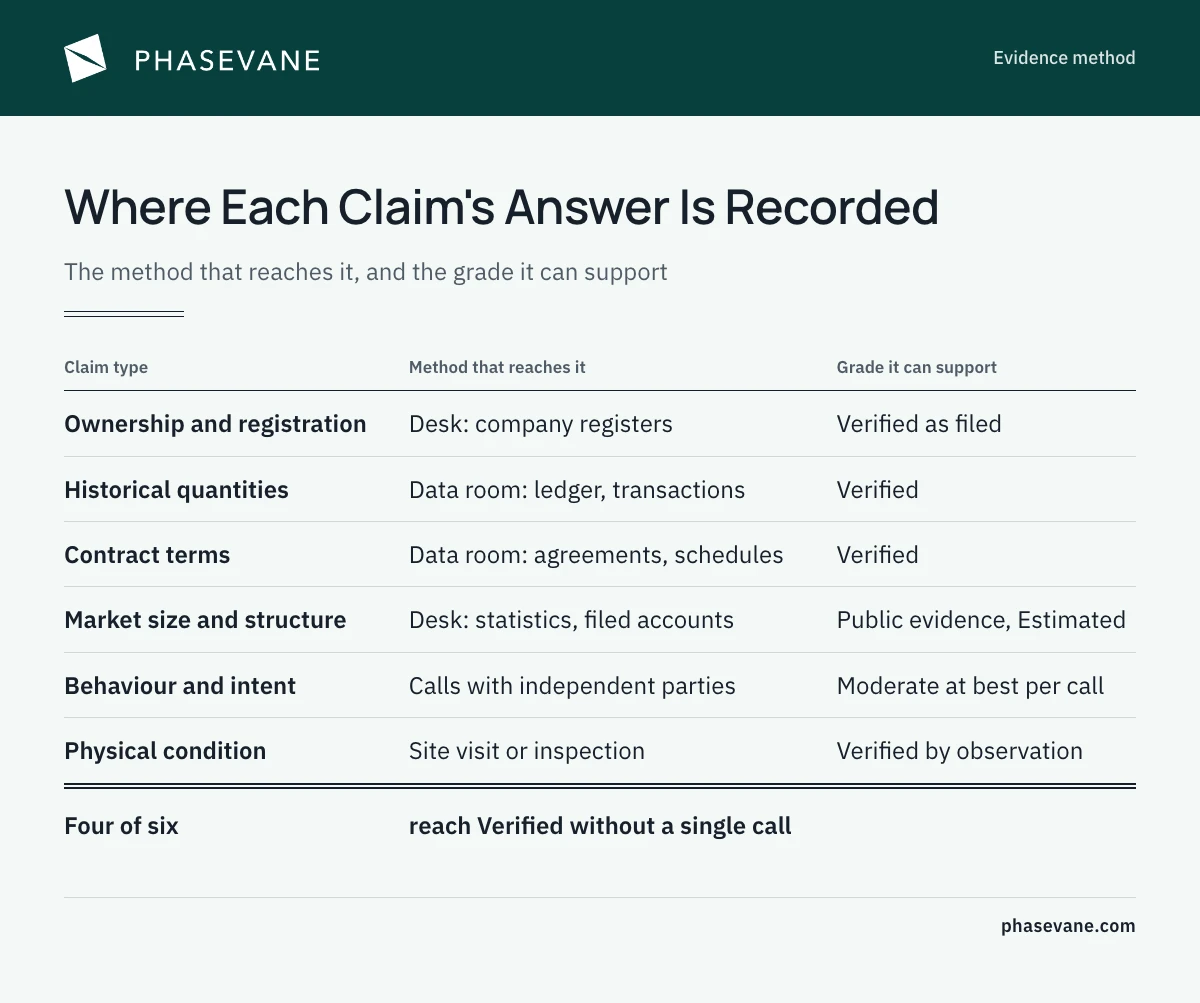 *Match the method to where the answer is recorded.*
Read down the last two columns. Three of six claim types can reach Verified from desk research and the data room alone, and a fourth through a site visit; none of the four needs a call. That is why most supply and customer claims in a deal can be settled by desk research plus the data room, and why commissioning calls on them adds cost and lowers the grade.
The decision ladder
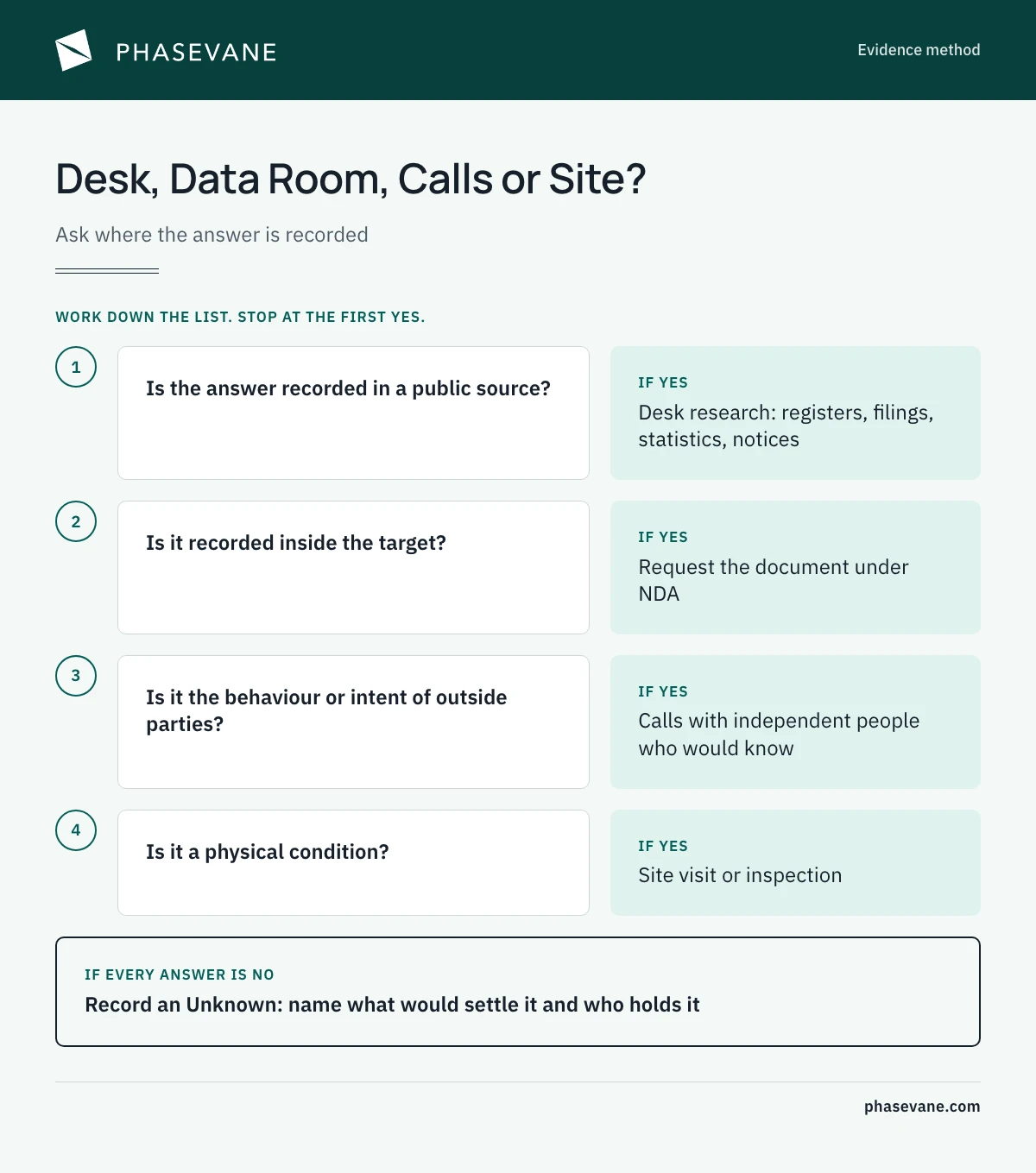 *Five questions in order.*
- Is the answer recorded in a public source? Registers, filings, official statistics, trade-remedy notices, planning records. If yes: desk research. See trade data for supplier research for one of the most useful and most misread public sources.
- Is it recorded inside the target? Ledgers, contracts, purchase orders, customs declarations. If yes: request the document under NDA. If management will not provide it, the refusal is itself information.
- Is it behaviour or intent of identifiable outside parties? Customers, distributors, competitors, suppliers. If yes: calls, with independent people who would know.
- Is it physical? Equipment, stock, site condition. If yes: a visit or an inspection.
- None of these in the time available? Record an Unknown, name what would settle it and who holds it, and let the committee decide whether to condition its approval.
What a call can and cannot do
A call is a source like any other. Ask the same two questions: is the person reliable (independent, in a position to know, with a track record) and is what they say credible (specific, plausible, consistent with other evidence)? The rules for turning that into a grade and a confidence level are in evidence grading.
Calls are strong for:
- how customers choose and what would make them switch;
- how a supplier prioritises customers when capacity is short;
- what competitors are doing now that is not yet in any filing;
- practice behind a document: how a framework agreement is actually used.
Calls are weak for:
- numbers that sit in a ledger. A former employee's memory of the supplier mix is worse evidence than the purchase ledger;
- anything the person has an interest in. A call with the target's own supplier about its capacity is Supplier-stated, however friendly;
- generalisation. Three calls are three views. Selection decides a lot of what you hear.
A worked example
Company S, a UK distributor of electrical components, claims: "Customers stay with us because no competitor can match our next-day availability."
Desk and data room first. The claim splits into two statements: (a) Company S offers next-day availability on most lines; (b) competitors do not, and that is why customers stay. For (a), order and dispatch records (Verified) show 91% of order lines dispatched the same or next day in FY26. For the first half of (b), competitors' websites state next-day dispatch on "stocked lines" (Supplier-stated, each about itself). Desk research could not settle the second half: why customers stay.
Calls next. That is behaviour, so calls are the right method. Six calls with buyers at customers of different sizes, two of whom had moved part of their spend to a competitor in the last year. Four of six named availability as the main reason they stay; two named credit terms. Both buyers who moved spend said a competitor had matched availability on their core lines.
The finding. Statement (a) holds, High confidence. Statement (b) holds in part: availability matters to most buyers interviewed, but it is matched by at least one competitor for some core lines. Confidence Moderate: six independent buyers, consistent with each other, but a small and self-selected sample. Action: test. Ask for customer-level churn data by product line, which would show whether the losses cluster where competitors have matched availability.
The calls added what no document could: the reason customers stay. They did not replace the dispatch records, and the final question (does churn cluster where competitors match?) goes back to the target's own data.
Commissioning calls well
- Write the claim and the statement before the call. A call scheduled "to understand the market" rarely settles anything.
- Ask for specifics. "When did you last move volume, and why?" beats "How do you rate them?"
- Look for disconfirmation. Include people who left, not only people who stayed.
- Log each call as a source, with date, role, independence and grade. The UK intelligence community's guidance describes confidence in terms of the information base and how it was analysed (S1); a call with no record of who said what cannot support either.
- Respect confidentiality. Calls with current employees of customers or suppliers can stray into confidential information. Use providers with clear compliance rules, and do not ask for what the person should not share.
When you brief the work, say which claims need calls and which need documents; see how to brief commissioned research. Capacity claims are a common case where a call with the supplier feels useful and a written reservation is what actually counts: see manufacturing capacity claims. The full claim list for a deal is in commercial due diligence.
What PhaseVane does, and does not do
A PhaseVane Decision Brief reads claims against public evidence and the target's documents under NDA. It does not include interviews or site visits. Where a claim needs calls or a site visit, the brief says so and names who should do it.
If you are not sure whether a claim needs calls at all, test it against the records first. A Claim Check reads one supply claim against public evidence and anything you can share, in three working days, for GBP 395: test one claim against the records first. For the claims that carry the price, a Decision Brief tests up to eight in five working days, from GBP 3,500: have the claims tested.
Sources (checked 8 October 2026): Explaining Uncertainty in UK Intelligence Assessment, GOV.UK, https://www.gov.uk/government/publications/explaining-uncertainty-in-uk-intelligence-assessment/explaining-uncertainty-in-uk-intelligence-assessment.
Related Research
See all research notesTopic: Commissioning Research
How to Brief Commissioned Research: Question, Scope and Budget
A one-page brief for commissioned research: the decision, the claims, the use of each answer, what you can share, scope and budget. Example example.
Commissioning ResearchRead MoreSupply Market Analysis for a Decision: Which Assumptions Hold?
Supply market analysis that answers an investment or strategy decision: five questions, the evidence for each, and a sample worked read on resin supply.
Supply Market AnalysisRead MoreEvidence Grading: How Much Weight Can a Claim Bear?
An evidence grading system for deal and commercial decisions: six grades, confidence ceiling rules, and what to borrow from UK intelligence assessment.
Evidence GradingRead More