
Manufacturing Capacity Claims: Can the Supplier Really Deliver?
How to verify a manufacturer's capacity claim before it enters a deal model: four capacity numbers, the evidence for each, and a sample worked case.
On This Page
The growth case in the model needs more product next year. Either the target's own plant has to make it, or a contract manufacturer does. The management presentation says the capacity is there: "our key partner has committed capacity to support 30% volume growth". Before that line becomes revenue in the base case, someone has to say what the claim actually rests on.
This page shows how to verify a manufacturer's capacity claim in a deal context. It separates the four numbers that a capacity claim usually blurs together, sets out the evidence for each, and works one example case through to a status, a confidence level and an action. The aim is a decision: does the growth stay in the base case, move to upside, or wait for a document?
In short
- A capacity claim usually mixes four numbers: nameplate (what the equipment could make), demonstrated (what it has made), available to the target (what is left after other customers), and committed (what someone has agreed in writing to supply).
- Only committed capacity belongs in a base case without conditions. Available capacity can support a plan with stated confidence. Nameplate supports nothing on its own.
- The usual evidence ladder runs from Supplier-stated (brochures, emails) to Public evidence (planning registers, announcements) to Verified (signed reservations, output records reconciled to the target's own receipts).
- Check timing as well as volume. A new line that opens after the plan year does not serve the plan year.
- Shared lines are where claims fail. A supplier's spare capacity belongs to all its customers until it is reserved for one.
Four numbers inside one capacity claim
Most capacity sentences are true about one of these numbers and silent about the others.
| Number | What it means | Typical source | Grade it usually reaches |
|---|---|---|---|
| Nameplate | What the line could make running continuously at rated speed | Supplier brochure, website, equipment specification | Supplier-stated |
| Demonstrated | What the line actually made over a recent period, including downtime | Supplier output records; best sustained run | Supplier-stated, Verified if reconciled to the target's receipts |
| Available to the target | Demonstrated ceiling, less what other customers use | Output records split by customer; allocation plan | Estimated |
| Committed | Volume someone has agreed in writing to supply, for stated dates | Supply agreement clause, capacity reservation letter | Verified |
The gap between nameplate and demonstrated is normal: maintenance, changeovers, staffing, material shortages. The gap between demonstrated and available is where most capacity claims go wrong, because spare capacity on a shared line is not yours until someone reserves it.
A worked example
Company K is a UK pet food brand that does not own a factory. A contract manufacturer, M, fills its products on one line, line 2. Company K's plan for the next financial year (FY27) needs 30% more volume. Slide 16 of the management presentation says: "M has committed capacity to support our growth."
The volumes. Company K's purchase records (Verified, reconciled to its accounts) show it took 1.80 million units from line 2 in FY26. Growth of 30% means 1.80m x 1.30 = 2.34 million units in FY27, an extra 0.54 million.
Nameplate. M's website gives line 2 a rated output of 6.00 million units a year (Supplier-stated).
Demonstrated. M's monthly output report, shared with Company K, shows 4.20 million units over the last 12 months, which is 4.20 / 6.00 = 70% of nameplate. Its best three consecutive months produced 1.20 million units; annualised, that is 1.20 x 4 = 4.80 million, or 80% of nameplate. Both figures come from M's own report (Supplier-stated), but Company K's 1.80m sits inside the 4.20m and matches its receipts, which supports the report's reliability.
Available. Other customers took 4.20 - 1.80 = 2.40 million units. If the best three-month rate is the practical ceiling, spare capacity is 4.80 - 4.20 = 0.60 million units a year (Estimated). Company K's extra 0.54 million would use 0.54 / 0.60 = 90% of it, leaving 0.06 million.
The sensitivity. If M's other customers grow by 5% next year, they need 2.40 x 0.05 = 0.12 million more units. That is twice the remaining 0.06 million, so the line falls 0.06 million short even before any breakdown.
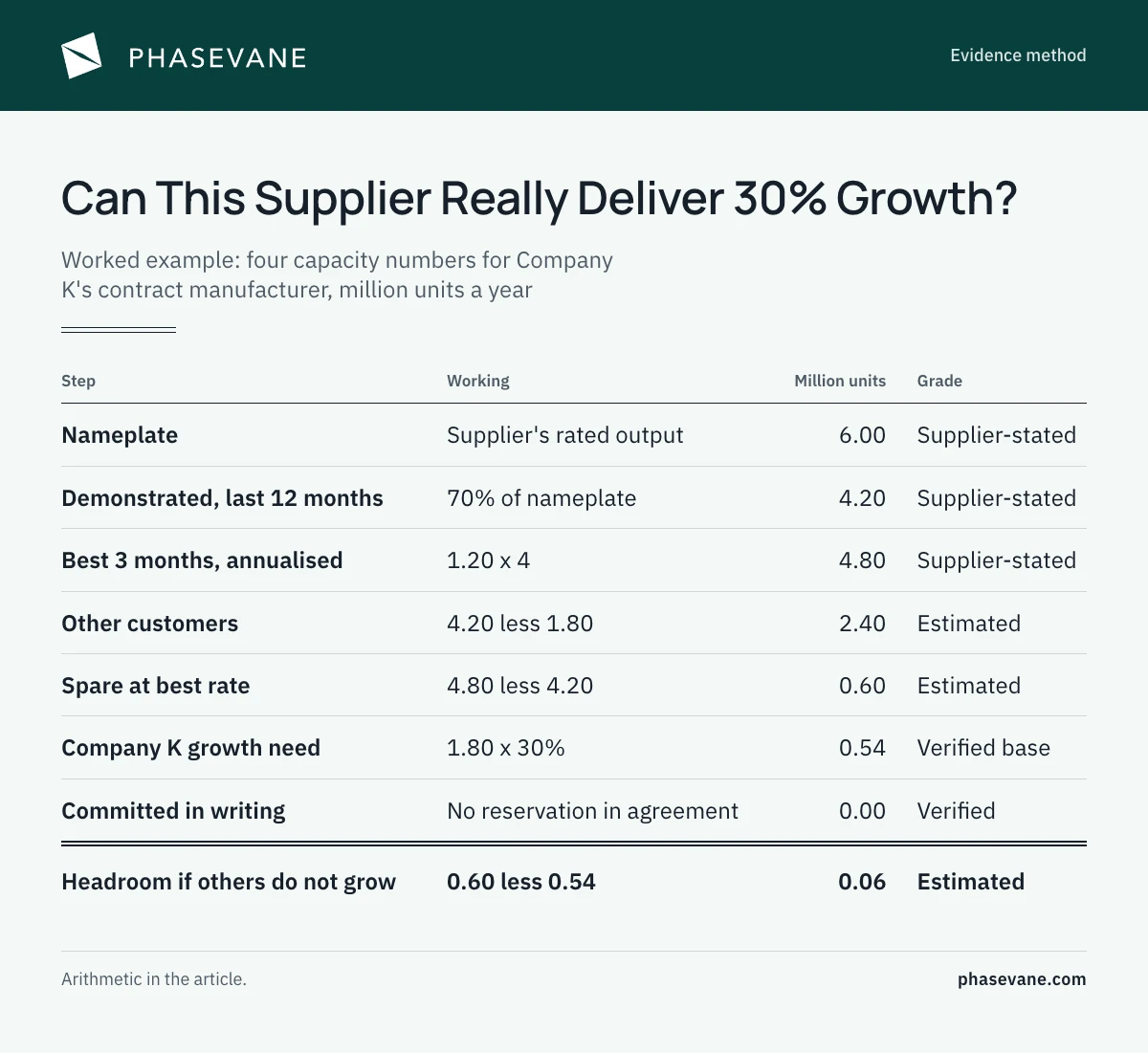 *Line 2 capacity read for Company K.*
Committed. The supply agreement with M (Verified) sets prices, minimum order quantities and payment terms. It contains no capacity reservation. The only written support is an email from M's sales director: "happy to support your growth plans" (Supplier-stated).
Timing. M announced a new line 3, "operational in spring 2027" (Supplier-stated). The local planning register shows permission granted for the building extension (Public evidence). No evidence was found that equipment for line 3 has been ordered (Unknown). Company K's FY27 runs to 31 December 2027, so line 3 could help in the second half if it opens on time, but not in the first quarter, when the plan needs the extra volume.
The finding.
| Element | Reading |
|---|---|
| Claim | "M has committed capacity to support our growth" |
| Status | Not established as a commitment. As arithmetic, the growth fits on line 2 only if other customers do not grow and the best three-month rate holds all year |
| Confidence | Low. The critical evidence for "committed" is a supplier email; the critical evidence for "available" is the supplier's own output report |
| Contradiction | Claim vs evidence, open: the claim says committed; the agreement has no reservation. Would resolve it: a dated, volume-specific reservation from M |
| Commercial implication | The 0.54 million units of growth carry about 0.54m x GBP 1.10 = GBP 0.594 million of contribution (example contribution per unit). That sum depends on capacity no one has promised |
| Action | Test. Ask M, through management, for a capacity reservation of 2.34 million units for FY27 with monthly phasing, and 24 months of line 2 output by month. Until then, show the growth as upside, not base case |
The evidence ladder for capacity
Grade each capacity number separately. A claim can have a Verified volume history and a Supplier-stated commitment at the same time, and the weakest critical one sets the confidence (see evidence grading for commercial decisions).
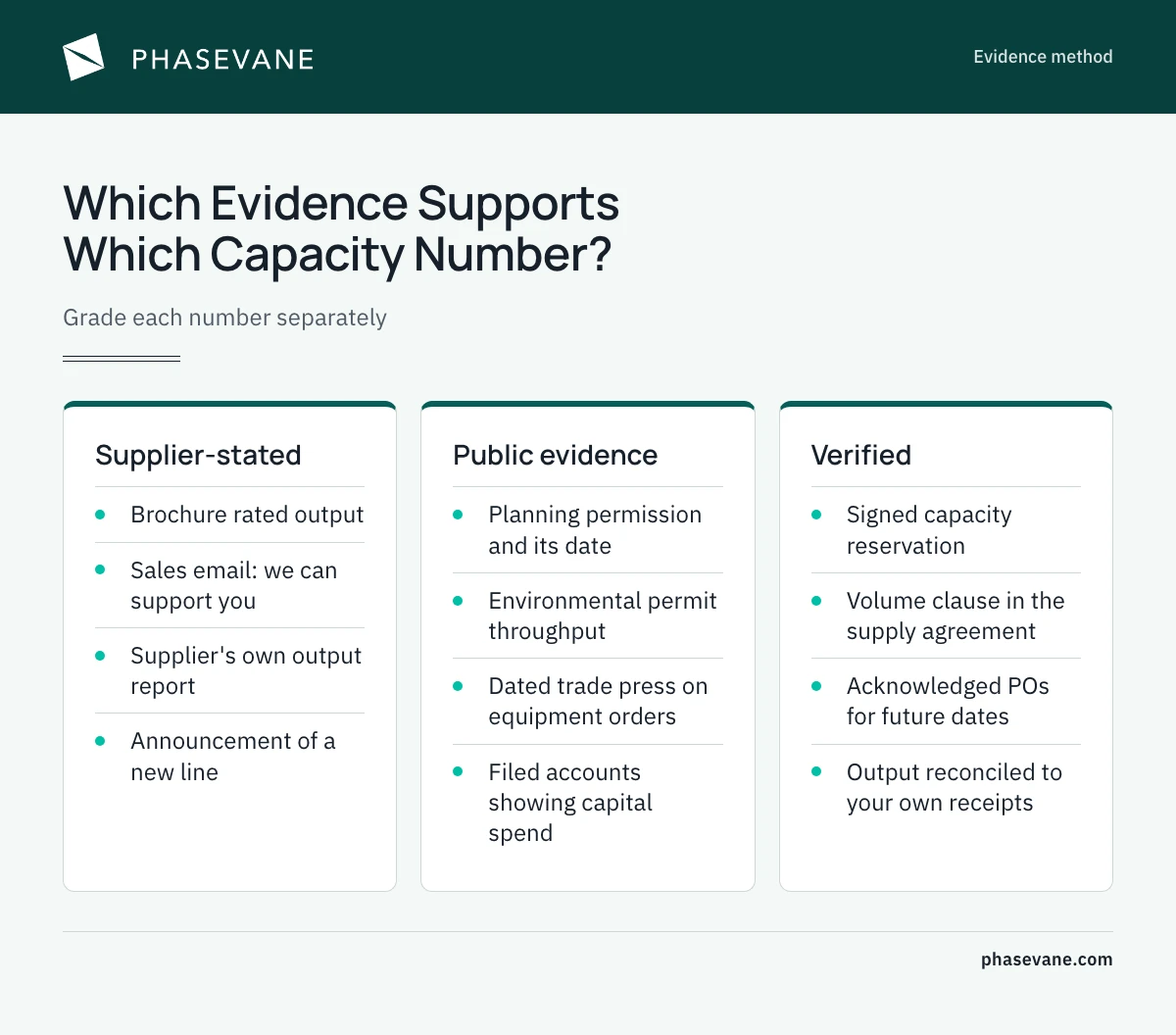 *Which evidence supports which capacity number.*
- Supplier-stated: brochure ratings, sales emails, "we can support you", the supplier's own announcement of a new line. Often true. Still a claim.
- Public evidence: planning permissions, building control records, environmental permits that state throughput, trade press reporting an equipment order with a date, the supplier's filed accounts showing capital spending. Useful for timing and plausibility; rarely specific to one customer.
- Verified: a signed capacity reservation or volume clause, purchase orders acknowledged for future dates, output records that reconcile to the target's own receipts, invoices for equipment.
- Estimated: your arithmetic, with the inputs shown. Most "available capacity" figures are estimates and should say so.
Planning and permit records are especially useful for the timing test because they carry dates set by someone other than the supplier. They show that a building is allowed, not that a line will run.
When the capacity claim is about the target's own plant
The same four numbers apply when the target says it can grow "without significant capital expenditure". Nameplate comes from equipment specifications; demonstrated from production records and shift patterns; available from the gap between today's shifts and a realistic maximum (another shift needs people, and hiring is a lead time); committed is replaced by a different question: what has to be bought, hired or approved, and by when. Production records, payroll by shift and maintenance logs settle most of it. Energy or utility consumption by month can corroborate an output trend when production records are thin, because the two should move together.
What to ask management
- Which line, for each product family, and who else uses it?
- What did that line make in each of the last 24 months, and what share was ours?
- Is there a written capacity reservation or volume commitment for next year? Please share it.
- What is the evidence that the new line will run by the date in the plan: equipment orders, installation schedule, permits?
- If the line is full, which other manufacturer has made our products to approved standard?
Questions 3 and 5 often change the answer most. A team with only one day of management access should start there. If calls with former employees or customers of the manufacturer would add something, our guide on when desk research is enough helps decide.
Where capacity sits in the wider check
Capacity is one of eight supply claims in a Supply Base Check, alongside concentration, dual sourcing, origin, trade remedies, price protection, lead times and audits: see supply chain due diligence in an acquisition. If the claim came from a management presentation, the method in testing management presentation claims shows how to split it before testing. If the question is whether other manufacturers could take the volume, start with supplier market depth.
The UK intelligence community describes confidence as reflecting the soundness and stability of the foundations of a judgement (S1). For capacity, stability matters as much as soundness: a supplier email can be honest today and overtaken by a larger customer's order next month. That is why a written reservation is worth more than a confident conversation.
Have one capacity claim read
A Claim Check reads one claim, such as a capacity commitment in a management presentation, against public evidence and anything you can share, and returns a written evidence note with a status, confidence, what would settle it and the questions for management. GBP 395, three working days. Send one capacity claim for a Claim Check.
If capacity is one of several supply claims carrying the price, a Supply Base Check reads up to eight of them and delivers a Decision Brief in five working days, from GBP 3,500, with the Claim Check fee credited in full if you instruct it within 60 days: have every supply claim checked.
Sources (checked 8 October 2026): Explaining Uncertainty in UK Intelligence Assessment, GOV.UK, https://www.gov.uk/government/publications/explaining-uncertainty-in-uk-intelligence-assessment/explaining-uncertainty-in-uk-intelligence-assessment.
Related Research
See all research notesTopic: Supply Chain Diligence
Supply Chain Due Diligence in an Acquisition: Do the Supply Claims Hold?
The commercial side of supply chain due diligence: eight supply claims a target makes, the records that settle each, and how findings reach the deal terms.
Supply Chain DiligenceRead MoreSupply Market Analysis for a Decision: Which Assumptions Hold?
Supply market analysis that answers an investment or strategy decision: five questions, the evidence for each, and a sample worked read on resin supply.
Supply Market AnalysisRead MoreEvidence Grading: How Much Weight Can a Claim Bear?
An evidence grading system for deal and commercial decisions: six grades, confidence ceiling rules, and what to borrow from UK intelligence assessment.
Evidence GradingRead More