
Supply Chain Due Diligence in an Acquisition: Do the Supply Claims Hold?
The commercial side of supply chain due diligence: eight supply claims a target makes, the records that settle each, and how findings reach the deal terms.
On This Page
The target sells products it does not make, or makes them from parts it buys. Its information memorandum describes a supply base that is diversified, dual-sourced, moving out of China, price-protected and ready for growth. Your model depends on those sentences: gross margin, stock cover, growth capacity and the absence of a supply risk discount.
Supply chain due diligence in an acquisition has two meanings, and deal teams lose time when they mix them up. One is regulatory: is the target meeting its legal duties on human rights and environmental risk in its supply chain? The other is commercial: are the target's claims about its suppliers true, and what happens to the investment case if they are not? This guide covers the commercial side. It lists the eight supply claims that most often carry value, the records that settle each, and how a finding becomes a price adjustment, a warranty, a condition or a 100-day plan item.
In short
- Commercial supply chain due diligence tests what the target says about its suppliers. Regulatory supply chain due diligence tests whether it meets legal duties. Scope them separately and give them to different people.
- Eight claims carry most of the value: supplier concentration, dual sourcing, country of origin, capacity, trade-remedy exposure (anti-dumping and similar extra import duties), price and currency protection, lead times, and supplier audits.
- Each claim splits into statements that must all be true. "Dual-sourced" usually means a second factory is named; the question is whether it has ever made the product.
- Most claims can be settled from records inside the target: the purchase ledger, purchase orders and receipts, supply agreements, customs declarations, registry extracts.
- Measure concentration by ultimate owner, origin by value (not containers), and capacity by written commitment (not by an email).
- Every finding should end in one place: the model, the price, the warranty, a condition before signing, or the 100-day plan.
Commercial vs regulatory supply chain due diligence
The search results for this topic lean heavily towards the regulatory meaning. That work matters, and it has its own legal tests. In the UK, section 54 of the Modern Slavery Act 2015 requires a commercial organisation that supplies goods or services and has total turnover at or above a prescribed amount to prepare a slavery and human trafficking statement for each financial year (S1). The prescribed amount is GBP 36 million (S2). In Germany, the Supply Chain Due Diligence Act (LkSG) applies to companies with, as a rule, at least 1,000 employees in Germany from 1 January 2024 (S3). Last checked: 8 October 2026. This is commercial guidance, not legal advice: whether a target or its buyer is in scope, and what follows, is a question for counsel.
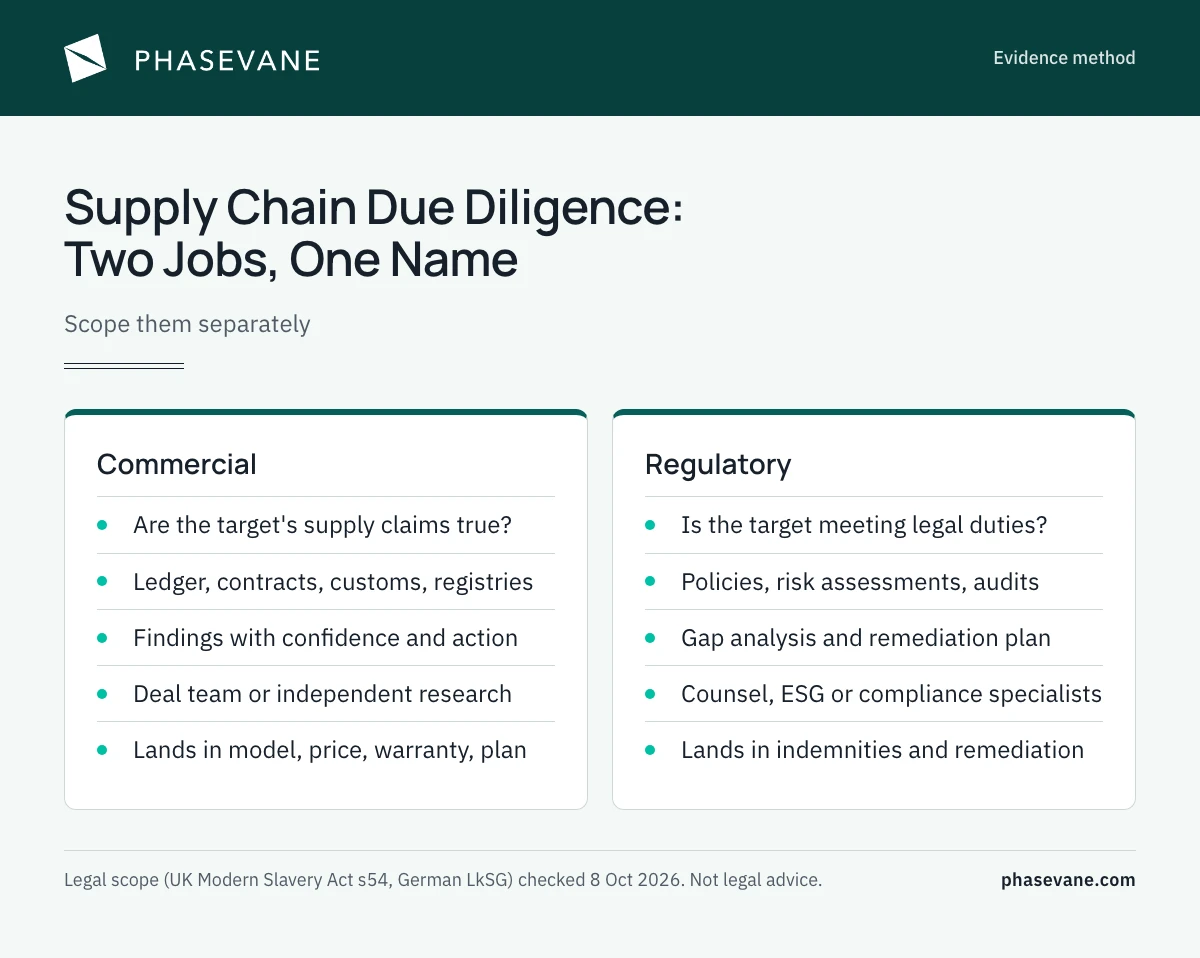 *Two different jobs that share a name.*
| Commercial supply chain due diligence | Regulatory supply chain due diligence | |
|---|---|---|
| The question | Are the target's supply claims true, and what do they do to value? | Is the target meeting its legal duties in its supply chain? |
| Typical output | Claim-by-claim findings with confidence and action | Gap analysis against a law or standard, remediation plan |
| Evidence | Purchase ledger, contracts, customs records, registries | Policies, risk assessments, audits, statements, grievance records |
| Who usually does it | Deal team, commercial adviser, independent research | Counsel, ESG or compliance specialists |
| Where findings go | Model, price, warranties, conditions, 100-day plan | Indemnities, remediation, disclosure |
The two meet at one claim, supplier audits, which appears in both. Everything else on this page is commercial.
The eight supply claims that carry value
These are the claims PhaseVane sees most often in information memoranda and management presentations for product businesses. Each is quoted the way a target tends to write it, split into the statements that must be true, and paired with the record that usually settles it.
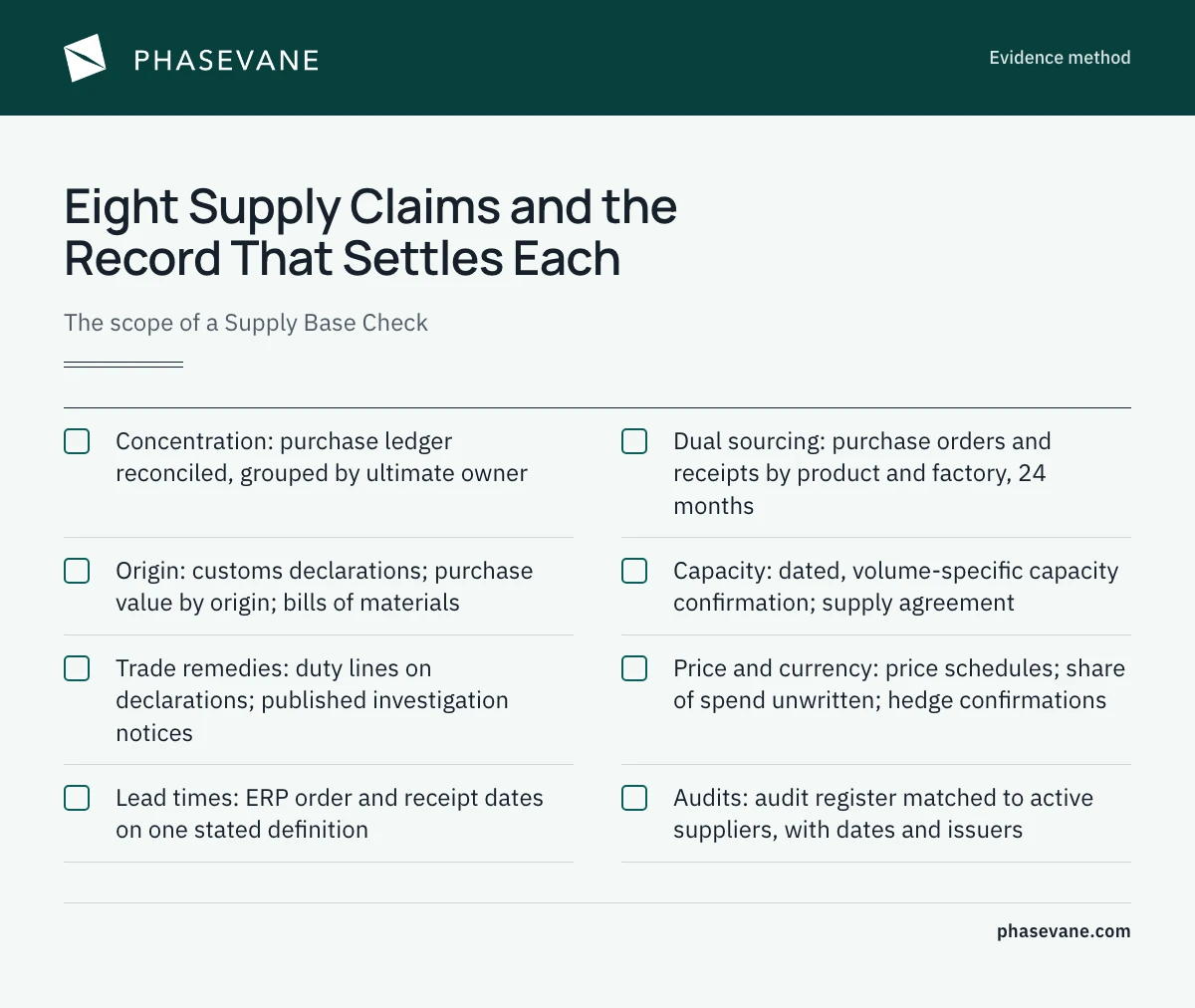 *The eight claims in a Supply Base Check, with the record that usually settles each.*
1. Supplier concentration. "No single supplier accounts for more than 15% of purchases." Statements: the largest supplier account is at or below 15%; no group of commonly owned suppliers exceeds it. Settled by: the purchase ledger reconciled to the accounts, plus registry extracts for the larger suppliers. The trap is counting accounts, not owners.
2. Dual sourcing. "All of our top 50 products are dual-sourced." Statements: each product has two factories that have produced it; both are approved for that exact item; if the claim says so, they are in different countries. Settled by: purchase orders and receipts over 24 months by product and factory, and pre-production approval records. A second factory named in the product master file is a nomination, not a source.
3. Country of origin. "Over 40% of purchase volume now ships from Vietnam." Statements: the share is above the stated level on the stated measure; the goods are of that origin, not only dispatched from there. Settled by: customs declarations, purchase value by country of origin, and bills of materials for the main lines. Containers and value often tell different stories. Our page on trade data for supplier research explains what public trade statistics can and cannot add.
4. Capacity. "Our key partner has committed capacity to support 30% growth." Statements: a written commitment exists; it covers the volume; it is available in the period the plan needs. Settled by: the supply agreement, a dated volume-specific capacity confirmation, and the supplier's output records. See reading manufacturing capacity claims for the four capacity numbers to separate.
5. Trade-remedy exposure. "We have no material exposure to anti-dumping measures." Statements: no trade-remedy duty is paid today; no open investigation covers the target's products. Settled by: customs declarations (duty lines) and the published notices of the relevant trade-remedy authority. Whether a product falls inside an investigation's scope is a classification question for a customs adviser. PhaseVane does not give customs advice.
6. Price and currency protection. "Purchase prices are fixed in US dollars for 12 months, and our currency exposure is fully hedged." Statements: agreements fix prices for the period; they cover all material purchases; forward cover matches forecast purchases. Settled by: supply agreements and price schedules, the share of spend with no written terms, and hedge confirmations from the bank.
7. Lead times. "Average order-to-warehouse lead time has fallen from 16 to 11 weeks." Statements: both averages are right on the same definition and the same metric. Settled by: order and receipt dates from the ERP (the target's business management system), with the start date defined. Lead time drives stock cover and working capital, so a definition error goes straight into the cash line.
8. Supplier audits. "All active suppliers are audited annually." Statements: every active supplier has an audit within 12 months; the audits are independent. Settled by: the audit register matched to the active supplier list, with report dates and issuers.
What the findings usually look like
In PhaseVane's sample Supply Base Check on Company A, a UK furniture importer, the eight claims came out as follows.
| Claim | Status | Confidence | Action |
|---|---|---|---|
| Dual sourcing | Holds in part: 17 of 50 products meet the claim as worded | Moderate | Test |
| Supplier concentration | Holds by account (13.8%); not by owner (28.2% to 31.7%) | Moderate | Investigate |
| Shift to Vietnam | Holds on containers if the customs figure is right; China is 52% by value | Low | Test |
| Capacity for growth | Not established: no written commitment; new hall due after the plan year | Low | Hold |
| Trade-remedy exposure | Holds today; 9% of purchases sit in codes under an open investigation | Moderate | Investigate |
| Price and currency | Holds in part: 38% of USD purchases unhedged; 29% without written terms | Moderate | Test |
| Lead times | Holds on reconciled records | High | Proceed |
| Supplier audits | Does not hold as stated | High | Proceed |
Two things are worth noticing. Most claims hold in part. That is normal: management claims are usually true on the definition management chose. And a claim that fails can still carry High confidence, because confidence describes the evidence, not the claim. The supplier audit claim fails on strong records, so the team can rely on the finding.
The document request list
Ask early and ask by name. Most of the eight claims can be tested from ten files.
| File | Tests |
|---|---|
| Purchase ledger by supplier, 24 to 36 months, reconciled to the accounts | Concentration, origin by value, price movements |
| Purchase orders and goods receipts by product and factory | Dual sourcing, lead times |
| Product master file with nominated factories | Dual sourcing (nomination only) |
| Supply agreements and price schedules for the top suppliers | Capacity, price protection, change of control (for counsel) |
| Capacity confirmations or reservations, with dates and volumes | Capacity |
| Customs declarations or broker reports, with origin and duty lines | Origin, trade remedies |
| Bills of materials and origin declarations for the main lines | Origin of components |
| Hedge confirmations and treasury policy | Currency protection |
| Supplier audit register with report dates and issuers | Audits |
| Organisation chart for buying and quality | Who to ask, and whether the knowledge sits with one person |
Official registers add the ownership layer: company registry extracts for the larger suppliers, which often show that several accounts share a parent. Remember what a register shows. Companies House, for example, states on its own search service that it does not check the accuracy of the information filed; a registry extract proves what was filed, which is strong evidence but not the same as a confirmed fact.
A five-day evidence timeline
A Supply Base Check runs in five working days because most of the evidence already exists. The constraint is getting it.
- Day 0: agree the decision and the claims; send the document request list; sign the NDA.
- Day 1: quote and split each claim; start public evidence (registries, trade-remedy notices, supplier announcements).
- Days 2 to 3: read the data-room files against each statement; grade sources; log contradictions.
- Day 4: set confidence by rule; write the commercial implication and action for each claim; draft management questions.
- Day 5: deliver the Decision Brief and evidence register; one review call.
If a file is not provided, the claim it would test becomes an Unknown that names the file and who holds it. That is still a useful result: the committee can make approval conditional on it.
Where each finding goes
A supply finding is only useful if it lands somewhere in the deal.
- The model. "Model China exposure at 52% of purchase value." "Treat 22 single-supplied products as single-sourced."
- The price. Where a finding moves earnings or risk enough to change what you would pay.
- Warranties and indemnities. For example, defining supplier concentration by ultimate owner, or a specific indemnity for an open trade-remedy investigation. Wording is for counsel.
- Conditions before signing. A dated, volume-specific capacity confirmation from the key supplier.
- The 100-day plan. Qualifying second sources, renegotiating unwritten price terms, closing audit gaps.
Write this routing into the brief before the work starts, so every finding is written for its destination. The commercial due diligence guide shows how supply claims sit alongside market, customer and pricing claims, and testing management presentation claims shows how to extract them. When two records disagree, use the procedure in contradictions in due diligence evidence.
What to leave to someone else
Commercial supply chain due diligence reads claims against records. It does not include site visits, supplier interviews, customs classification, legal review of contracts, or a market-wide study of alternative suppliers. Where a finding needs one of those, the Decision Brief says so and names who should look. For the market around the supply base, see supply market analysis for a decision and supplier market depth. The grading rules behind every confidence level are in evidence grading for commercial decisions.
See a full Supply Base Check
The sample shows all eight claims worked through for Company A: each claim quoted, split, graded and sourced, contradictions beside conclusions, a summary position of test, and three items to close before signing. Read the sample Supply Base Check.
For your own target, a Supply Base Check reads up to eight supply claims against management data under NDA and public evidence and delivers a Decision Brief in five working days, from GBP 3,500. Commission a Supply Base Check.
Sources (checked 8 October 2026): Modern Slavery Act 2015 section 54, https://www.legislation.gov.uk/ukpga/2015/30/section/54; Modern Slavery Act 2015 (Transparency in Supply Chains) Regulations 2015 regulation 2, https://www.legislation.gov.uk/uksi/2015/1833/regulation/2; LkSG section 1, https://www.gesetze-im-internet.de/lksg/__1.html; Companies House search service, https://find-and-update.company-information.service.gov.uk/.
Related Research
See all research notesTopic: Supply Chain Diligence
Manufacturing Capacity Claims: Can the Supplier Really Deliver?
How to verify a manufacturer's capacity claim before it enters a deal model: four capacity numbers, the evidence for each, and a sample worked case.
Supply Chain DiligenceRead MoreSupply Market Analysis for a Decision: Which Assumptions Hold?
Supply market analysis that answers an investment or strategy decision: five questions, the evidence for each, and a sample worked read on resin supply.
Supply Market AnalysisRead MoreEvidence Grading: How Much Weight Can a Claim Bear?
An evidence grading system for deal and commercial decisions: six grades, confidence ceiling rules, and what to borrow from UK intelligence assessment.
Evidence GradingRead More