
Contradictions in Due Diligence Evidence: What If Two Sources Disagree?
What to do when due diligence sources disagree: two kinds of contradiction, six usual causes, and how each changes status and confidence. Example case.
On This Page
The information memorandum says one thing, the data room says another. Or two files in the data room disagree with each other, and the deadline does not move. The temptation is to pick the figure that fits the model, average the two, or move the disagreement to an appendix where the committee will not read it.
This guide sets out what to do instead with contradictory evidence in due diligence. It separates the two kinds of contradiction, which have opposite effects on a conclusion, lists the six usual causes and the check for each, and works through a sample lead-time case with one contradiction that can be explained and one that cannot yet.
In short
- There are two kinds of contradiction. A claim that disagrees with the evidence is the finding: it sets the claim's status. Two sources that disagree with each other are a confidence problem until explained.
- Six causes explain most source-vs-source disagreements: scope, timing, definition, metric, lineage and plain source error.
- Run the checks in that order. Most contradictions end at the first or second check.
- An explained contradiction costs nothing. An open one lowers confidence one level and names the document that would resolve it.
- Put the contradiction beside the conclusion it affects, with both sides quoted exactly.
- Describe the evidence, never the intent. "Does not hold as stated", not "misleading".
Two kinds of contradiction
Claim vs evidence. The company says one thing; the evidence you found says another. This is not a problem with your research. It is the answer. It sets the status of the claim: holds in part, not established, or does not hold as stated. It does not lower your confidence. If the evidence is strong, you can be highly confident that a claim does not hold.
Evidence vs evidence. Two sources you would rely on disagree with each other. Until you can explain why, you do not know which to believe, so confidence in any conclusion that rests on them drops one level. Once explained, the disagreement costs nothing and becomes a line of context.
Mixing these up causes the two most common errors: lowering confidence because a claim failed (penalising the finding), and treating an unexplained disagreement between sources as if it were a finding about the company.
Six causes, and the check for each
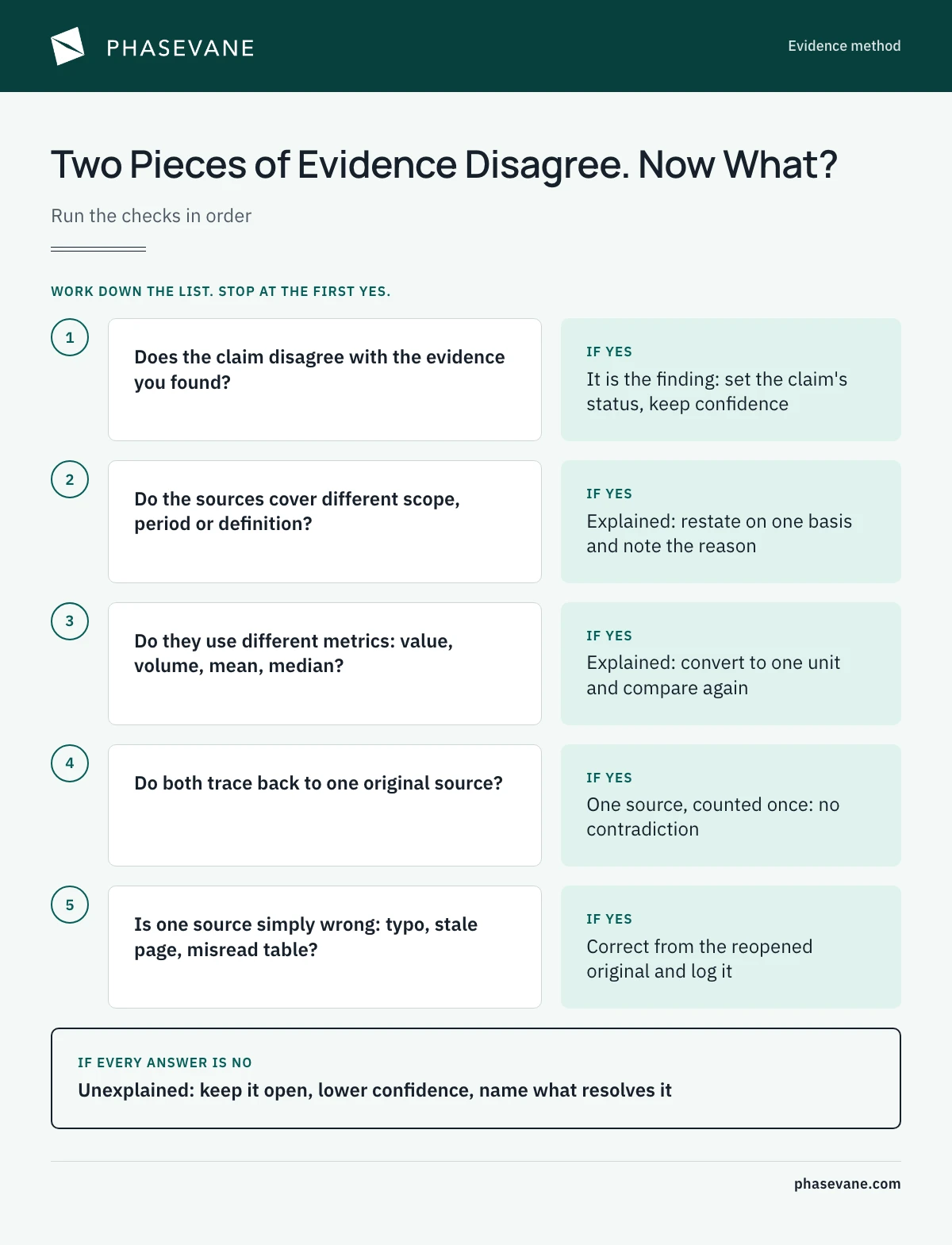 *Run the checks in order; most contradictions end early.*
| Cause | What is going on | The check |
|---|---|---|
| Scope | The sources cover different things: one forwarder, one site, one product line | Write down exactly what each covers. Is anything in one missing from the other? |
| Timing | Different periods, or one describes the future | Line up the dates. Is the claim about today, last year or next year? |
| Definition | The same word, measured differently: supplier account vs owner; start date of a lead time | Ask what the company means, and what each record counts |
| Metric | Value vs volume, mean vs median, units vs revenue | Restate both in the same unit and compare again |
| Lineage | The two sources are one source: an article repeating a release | Trace each to its original. Repeats count once |
| Source error | A typo, a stale page, a misread table | Reopen both originals. Never correct a source from memory |
If none of the six explains it, log it as unexplained and keep it open. An honest open contradiction is more useful to a committee than a forced explanation.
A worked example: two lead times
Company L is a UK importer of garden furniture. Its information memorandum says: "Average order-to-warehouse lead time is 9 weeks." The model sets stock cover and reorder points on that figure.
Source A: the lead-time report. A management report from the ERP system (the company's business management software), provided in the data room, shows an average of 9.1 weeks for FY26 (Supplier-stated: a company-prepared summary).
Source B: the purchase order lines. The raw extract of purchase order lines, with the date each order was issued, the date the supplier confirmed it and the date goods were received, gives an average of 10.7 weeks from order issue to receipt (Verified: transaction records). The median is 10.2 weeks.
Step 1: write both sides exactly. A: 9.1 weeks average, FY26, "order to warehouse". B: 10.7 weeks average, FY26, order issue to goods receipt.
Step 2: same thing? Same period. Same metric (mean). The definition differs: the report starts the clock at the supplier's confirmation date, not at order issue. In B's data, the gap between issue and confirmation averages 10.7 - 9.1 = 1.6 weeks.
Step 3: independent? Both come from the same ERP, but A is a summary and B the underlying records, so B can test A.
Step 4: the reason. Definition, explained: the report measures from confirmation, the claim says "order". On the claim's own words, the lead time is 10.7 weeks.
That is a claim-vs-evidence contradiction, and it is the finding: the claim holds on the company's measurement basis and does not hold as worded.
A second contradiction. The purchase order extract in the data room has 1,214 lines for FY26. A second extract, provided a week later for another question, has 1,187 lines, 27 fewer. Same period, same system. The likely reason is scope (cancelled lines removed from one of them), but that is not yet confirmed. Status: open. This is evidence vs evidence, and it lowers confidence one level until management confirms which extract is complete.
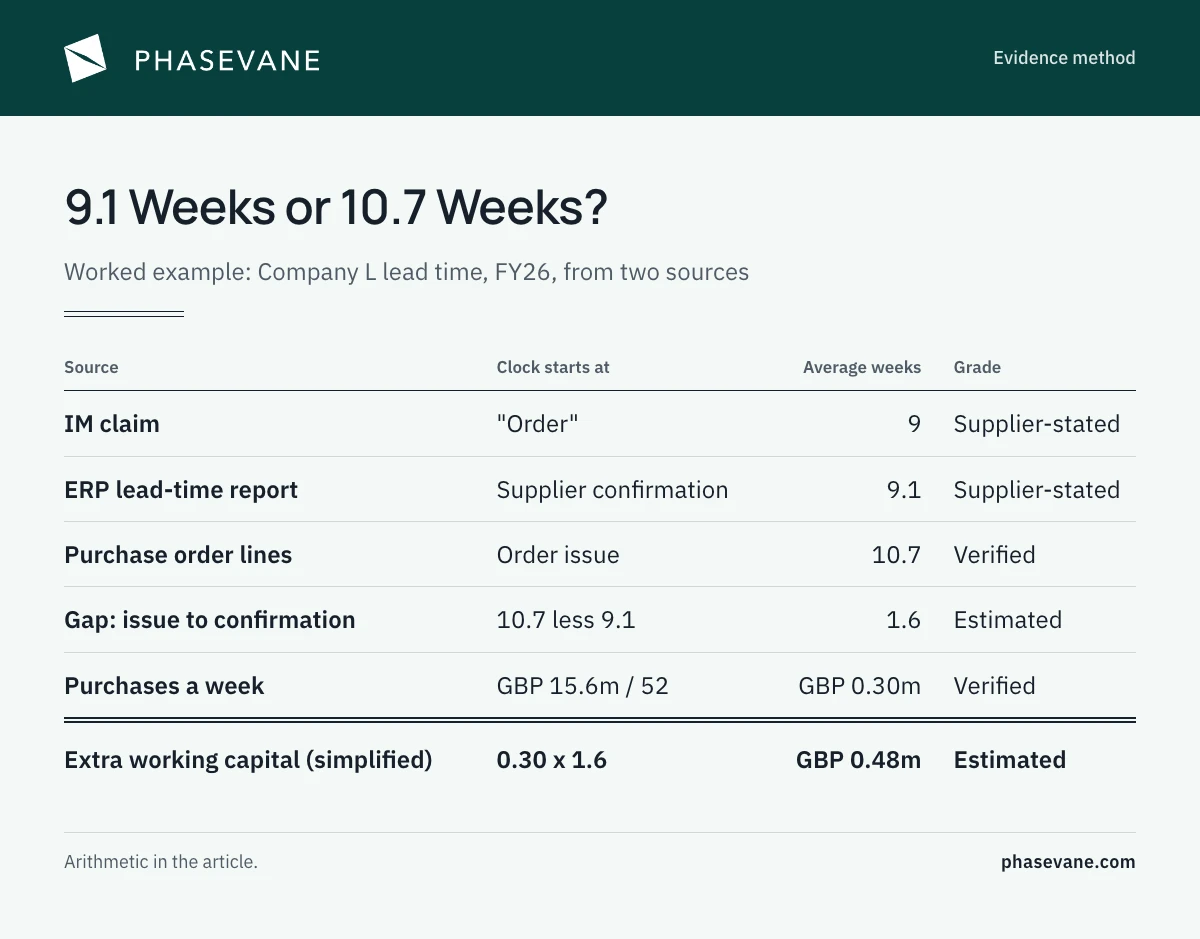 *The same year, measured from two start dates.*
Step 5: put it beside the conclusion.
| Element | Reading |
|---|---|
| Status | Holds from supplier confirmation (9.1 weeks). Does not hold as worded: from order issue, 10.7 weeks |
| Contradiction K-01 | Claim vs evidence, definition, explained |
| Contradiction K-02 | Evidence vs evidence, scope (unconfirmed), open: 1,214 vs 1,187 lines. Resolves with management's confirmation of the complete extract |
| Confidence | Moderate. The transaction records are Verified, which allows High; the open K-02 lowers it one level |
Step 6: decide the effect. Company L buys about GBP 15.6 million of goods a year, about 15.6 / 52 = GBP 0.30 million a week. If stock must cover the real lead time, and holding stock scales with lead time at constant purchases (a simplification), the extra 1.6 weeks means about 0.30 x 1.6 = GBP 0.48 million more working capital than the model assumes. Action: test. Model lead time at 10.7 weeks, and ask management to confirm which extract is complete.
How each contradiction changes the answer
| Situation | Effect on status | Effect on confidence | Typical action |
|---|---|---|---|
| Claim vs evidence, explained | Holds in part, or does not hold as stated | None | Adjust the model; test or proceed |
| Claim vs evidence, open | Not established, pending the document | None by itself | Hold the dependent assumption; ask |
| Evidence vs evidence, open | Usually unchanged | Down one level | Test; ask for the record that resolves it |
| Evidence vs evidence, explained | Unchanged | None | Note the reason beside the conclusion |
| Unexplained after all six checks | Not established, if the claim rests on it | Down one level | Investigate; name who could resolve it |
The confidence rules behind this table are in evidence grading for commercial decisions. UK intelligence assessment guidance draws a similar line between a judgement and the confidence placed in it: confidence reflects the soundness and stability of the foundations on which the judgement rests (S1).
Wording that keeps the reader's trust
- Quote both sides exactly, with their sources. The reader should be able to check you.
- Keep the claim's own words in quotation marks. Never paraphrase it into something easier to rebut.
- Describe the evidence, not the intent: "does not hold as stated", never "false", "inflated" or "misleading".
- Say "not yet confirmed" when the reason is your hypothesis.
- Put the contradiction in the same table row or paragraph as the conclusion. In the decision memo template, it sits on the claim's own line.
Common mistakes
- Averaging. Reporting 9.9 weeks because one source says 9.1 and another 10.7.
- Picking the convenient figure. Choosing the number that supports the case without explaining the other.
- Burying it. An appendix is where contradictions go to be ignored.
- Counting repeats. Five articles from one press release are one source. Public trade statistics and a company's own figure often look independent and are not, if one was derived from the other; see trade data for supplier research.
- Letting the AI choose. An AI summary that resolves a contradiction has usually dropped one side. Reopen both originals.
- Penalising the finding. A claim that fails on strong evidence is a High-confidence finding, not a Low-confidence one.
Most contradictions in a deal sit in supply and customer claims, where the company's own summaries can be checked against its transaction records: see supply chain due diligence in an acquisition and testing management presentation claims.
Use the procedure, or have a second reader
When a contradiction sits on a threshold that moves the price, an independent second reader is worth more than a faster first one. A PhaseVane Decision Brief puts every contradiction beside the conclusion it affects, from GBP 3,500: have a second reader on the claims that move the price.
Sources (checked 8 October 2026): Explaining Uncertainty in UK Intelligence Assessment, GOV.UK, https://www.gov.uk/government/publications/explaining-uncertainty-in-uk-intelligence-assessment/explaining-uncertainty-in-uk-intelligence-assessment.
Related Research
See all research notesTopic: Testing Claims
Management Presentation Claims: Which Ones Should You Test First?
Test supply claims in a management presentation before they enter the model: sort, split, triage by price impact, then grade. Annotated example slide.
Testing ClaimsRead MoreSupply Market Analysis for a Decision: Which Assumptions Hold?
Supply market analysis that answers an investment or strategy decision: five questions, the evidence for each, and a sample worked read on resin supply.
Supply Market AnalysisRead MoreEvidence Grading: How Much Weight Can a Claim Bear?
An evidence grading system for deal and commercial decisions: six grades, confidence ceiling rules, and what to borrow from UK intelligence assessment.
Evidence GradingRead More