
Decision Memo Template for Deal Teams: What Does the Committee Need to See?
A two-page decision memo template for investment committees: decision, position, claims with status and confidence, gaps. Filled example example.
On This Page
The committee meets on Tuesday. The diligence is in, the model is updated, and you have to put the decision on two pages that a committee member can read in ten minutes and challenge line by line. A narrative memo hides the one thing they most need to see: which conclusions rest on documents, which on management's word, and what is still unknown.
This decision memo template is built for that job. It has nine sections, each with a purpose and a writing rule, followed by a filled example excerpt. Copy the structure; the rules are what make it work.
In short
- One sentence of decision at the top, with who decides and by when.
- A position (proceed, test, hold or investigate) before any detail.
- What must close before signing, with who holds each item.
- One line per claim: status, confidence, action. Contradictions sit on the claim's own line.
- Gaps name the document that would settle them and who holds it.
- Confidence in words with one reason. Never a percentage.
The template
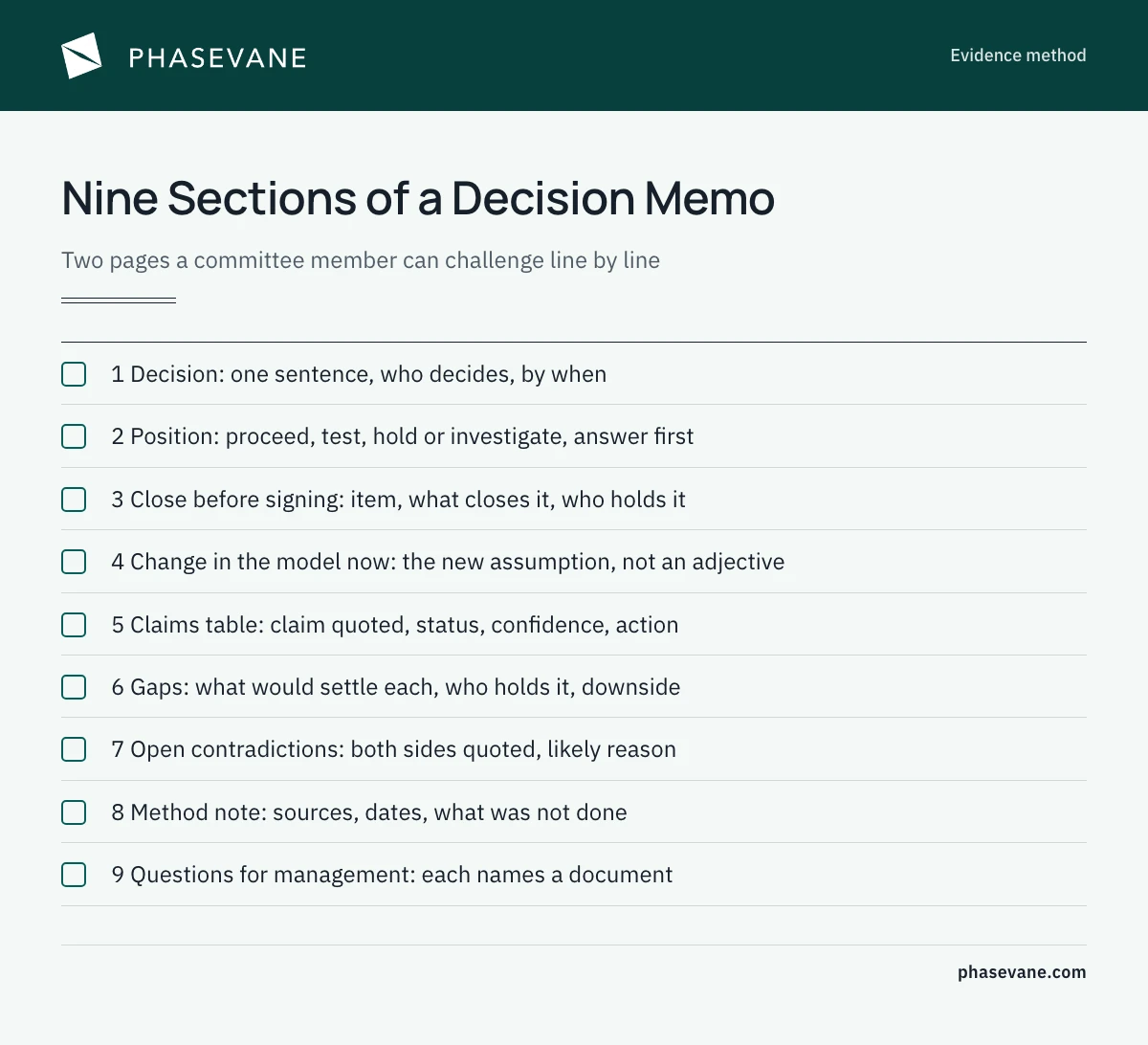 *Nine sections on two pages.*
| # | Section | Purpose | Writing rule |
|---|---|---|---|
| 1 | Decision | What is being decided, by whom, by when | One sentence. If it needs two, the decision is not yet clear |
| 2 | Position | The answer first | Proceed, test, hold or investigate, plus two or three sentences of reason |
| 3 | Close before signing | Conditions the committee can attach | Item, what would close it, who holds it |
| 4 | Change in the model now | Findings that alter numbers today | State the new assumption, not "lower than presented" |
| 5 | Claims table | Every claim relied on, one line each | Claim quoted exactly; status; confidence; action |
| 6 | Gaps | Unknowns that matter | What would settle it; who holds it; what happens if it goes the wrong way |
| 7 | Open contradictions | Disagreements not yet explained | Both sides quoted; likely reason or "not yet confirmed" |
| 8 | Method note | How far to trust the memo | Sources used, dates, what was not done (site visits, calls, legal review) |
| 9 | Questions for management | Turn gaps into requests | Each question names a document |
Three rules apply across all sections.
Status and confidence are different columns. Status says how far the evidence supports the claim as worded: holds, holds in part, not established, does not hold as stated. Confidence says how much weight the reading will bear: High, Moderate or Low. A claim that does not hold can carry High confidence. The rules for setting confidence are in evidence grading.
Every confidence level gets one sentence of reason. "Moderate: ownership of three supplier accounts is on official registers; the fourth rests on a shared address." The UK intelligence community's published guidance makes the same point: a confidence rating is supported by a statement of where the uncertainty comes from and how it could be reduced (S1).
Contradictions stay on the claim's line. Not in an appendix. See contradictions for the procedure.
A filled excerpt
Fund E is considering an add-on: Company V, a UK distributor of commercial cleaning chemicals, to join an existing platform.
1. Decision. Should Fund E's platform acquire Company V at the agreed price, with signing planned for 14 November, given that the case relies on five claims about Company V's suppliers and customers?
2. Position: Test. Proceed to signing after two items close. Three of five claims hold or hold in part on strong evidence; the supplier exclusivity the purchasing savings case relies on is not established.
3. Close before signing.
| Item | What would close it | Who holds it |
|---|---|---|
| Exclusive distribution rights for the main brand | The signed distribution agreement and any amendment | Company V's managing director |
| Customer definition in the warranty (C2) | Warranty wording that defines a customer by ultimate owner | Fund E's counsel |
4. Change in the model now. Model the largest customer group at 21% of revenue, not 14%. Remove the 1.5-point purchasing saving until exclusivity terms are seen.
5. Claims table.
| ID | Claim (quoted) | Status | Confidence | Action |
|---|---|---|---|---|
| C1 | "Exclusive UK distributor for our main brand" | Not established | Low | Hold |
| C2 | "No customer above 15% of revenue" | Holds by account; not by owner (21%) | High | Test |
| C3 | "Gross margin stable for three years" | Holds | High | Proceed |
| C4 | "Stock fully saleable" | Holds in part: 6% of stock older than 18 months | Moderate | Test |
| C5 | "No supplier price increases expected" | Not established (forecast) | Low | Hold |
6. Gaps (one shown). C1: the distribution agreement was not in the data room; only a supplier letter describing Company V as "our UK partner" (Supplier-stated). Would settle it: the signed agreement. Who holds it: Company V. If it goes the wrong way: the purchasing saving falls away and the brand could appoint a second distributor.
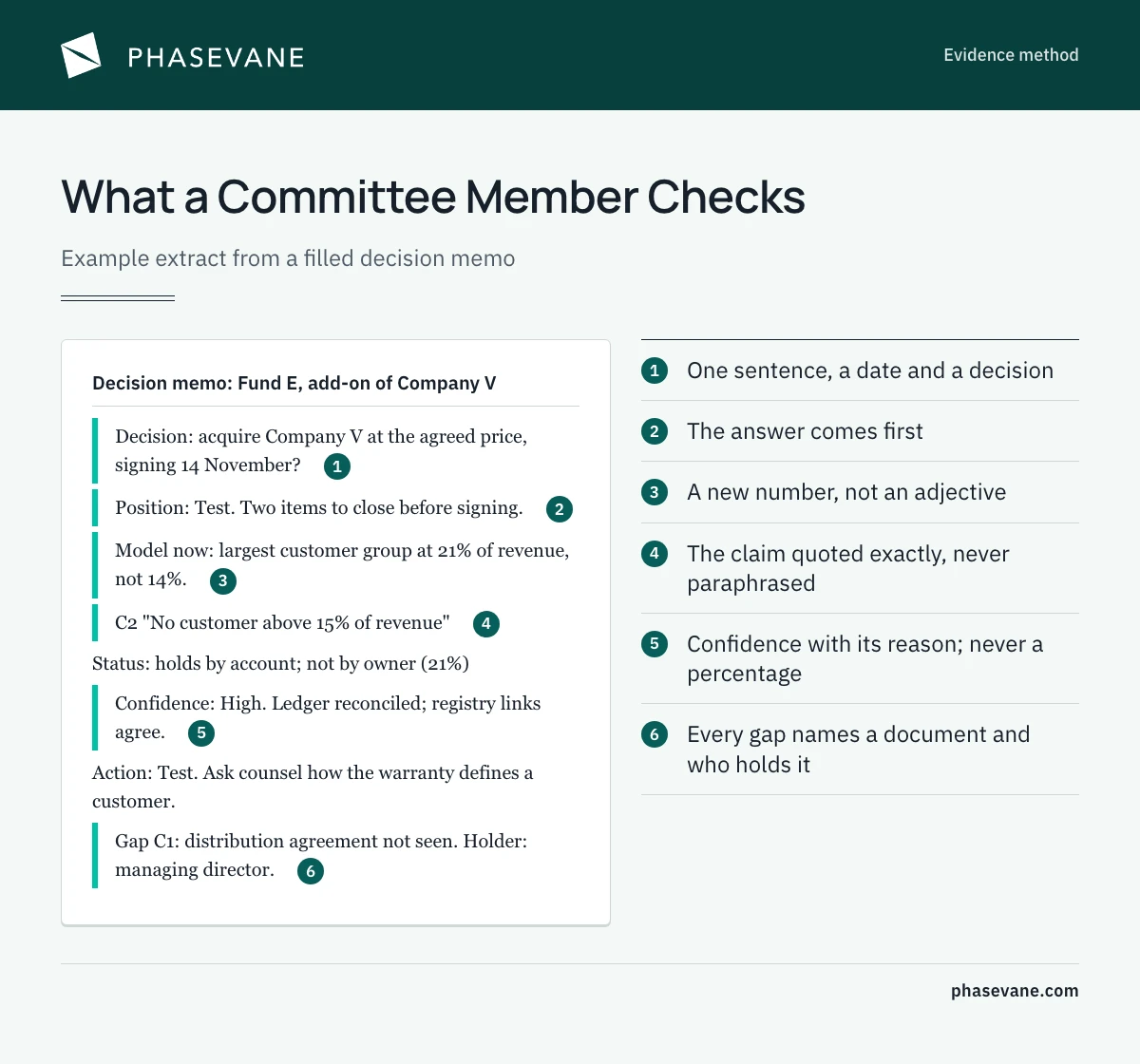 *What a committee member checks on one line.*
How to use the template
- Write section 5 first. The claims table drives everything else; sections 2 to 4 summarise it. Extract the claims using the method in testing management presentation claims.
- Limit the claims. Five to eight claims that carry the price. Background goes in the method note.
- Keep section 2 honest. If the position is test, say what is being tested and by when. "Proceed subject to confirmatory diligence" without items is not a position.
- Match the language to the evidence. "Holds" only where the evidence is strong enough for the committee to rely on. A management assurance is a reason to ask, not a finding.
- Say what was not done. A memo that does not mention the absence of calls or site visits invites the committee to assume they happened.
This template is the committee-facing summary. The underlying claim-by-claim work is described in commercial due diligence. If what you have is a set of flags rather than graded claims, see red flag report vs decision brief.
Get the full template
If the committee will ask who checked the evidence, a PhaseVane Decision Brief is written by a reader independent of the deal team, in five working days, from GBP 3,500: have the brief written by an independent reader.
Sources (checked 8 October 2026): Explaining Uncertainty in UK Intelligence Assessment, GOV.UK, https://www.gov.uk/government/publications/explaining-uncertainty-in-uk-intelligence-assessment/explaining-uncertainty-in-uk-intelligence-assessment.
Related Research
See all research notesTopic: Decision Outputs
Red Flag Due Diligence Report or Decision Brief: Which Does Your Deal Need?
Red flag due diligence report or graded decision brief? What each answers, what silence means, and why a commercial red flag needs an evidence grade.
Decision OutputsRead MoreSupply Market Analysis for a Decision: Which Assumptions Hold?
Supply market analysis that answers an investment or strategy decision: five questions, the evidence for each, and a sample worked read on resin supply.
Supply Market AnalysisRead MoreEvidence Grading: How Much Weight Can a Claim Bear?
An evidence grading system for deal and commercial decisions: six grades, confidence ceiling rules, and what to borrow from UK intelligence assessment.
Evidence GradingRead More