
Supply Market Analysis for a Decision: Which Assumptions Hold?
Supply market analysis that answers an investment or strategy decision: five questions, the evidence for each, and a sample worked read on resin supply.
On This Page
Your investment case, or your board paper, assumes something about a supply market: that inputs are available from several sources, that price rises can be passed on, that switching supplier is possible if one fails. A supply market analysis is supposed to test that. Too often it arrives as a description of the market (size, players, trends) that is accurate, well charted and silent on the assumption you are actually relying on.
This guide sets out supply market analysis built for a decision. It starts from what the decision needs to be true, asks five questions that usually decide it, names the evidence for each and the grade it can reach, and works one example read on a resin-dependent target through to a commercial implication.
In short
- Start from the decision and write down what it assumes about the supply market. Those assumptions are the scope.
- Five questions decide most cases: how many truly independent sources are there, is the market tight or slack, what does switching cost, how are prices formed and passed through, and how exposed is supply to trade measures and origin.
- Count independent sources at every tier. Three suppliers that buy from one upstream producer are one source of that input.
- Price pass-through is a question about the target's invoices, not about the market. Test it on records.
- Grade each answer. Market structure often stops at Public evidence or Estimated; the target's own pass-through and switching history can reach Verified.
Report or decision analysis
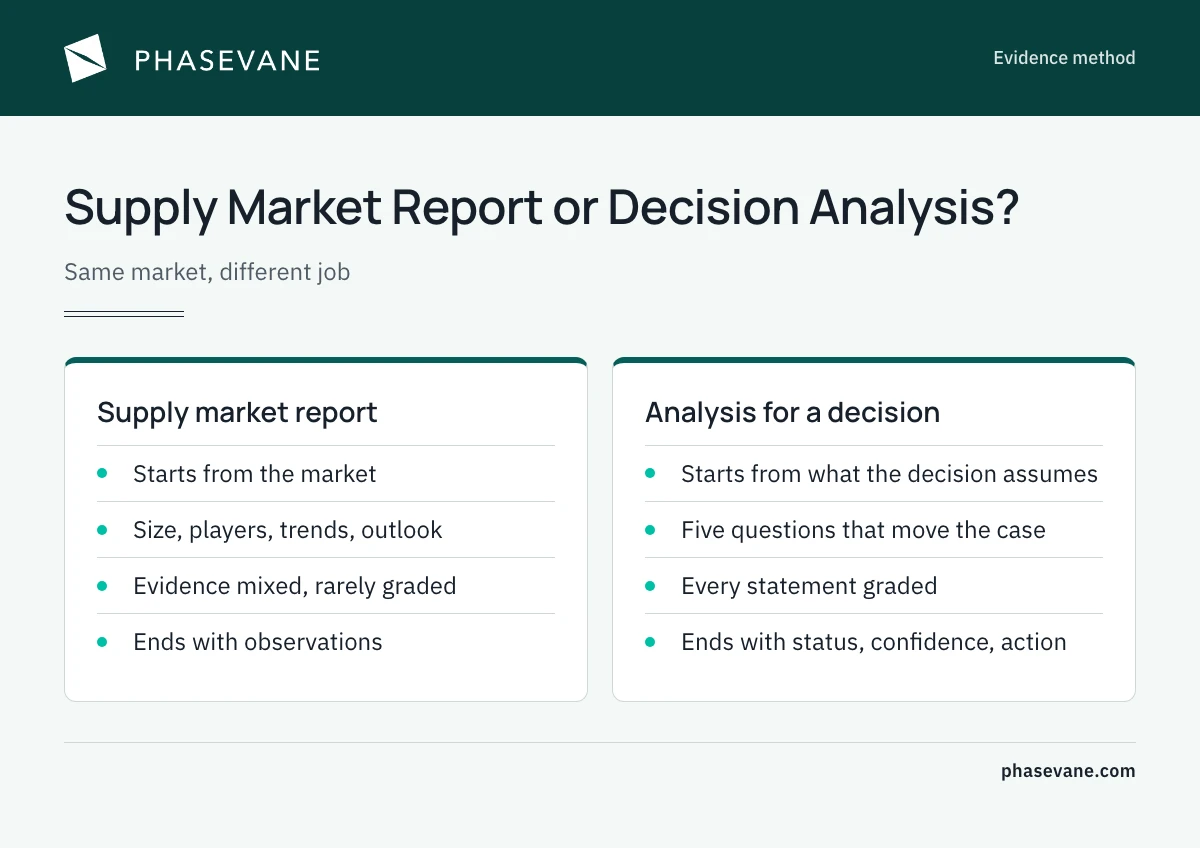 *Same market, different job.*
| Supply market report | Supply market analysis for a decision | |
|---|---|---|
| Starts from | The market | The decision and what it assumes |
| Covers | Size, players, trends, outlook | The five questions that move the decision |
| Typical length | Long | As long as the assumptions need |
| Evidence | Mixed, rarely graded | Graded per statement |
| Ends with | Observations | Status, confidence and action per assumption |
A report is useful background. A decision analysis tells you which line in the model or the board paper is safe, which is weaker than it looks, and what would settle it.
Five decision questions
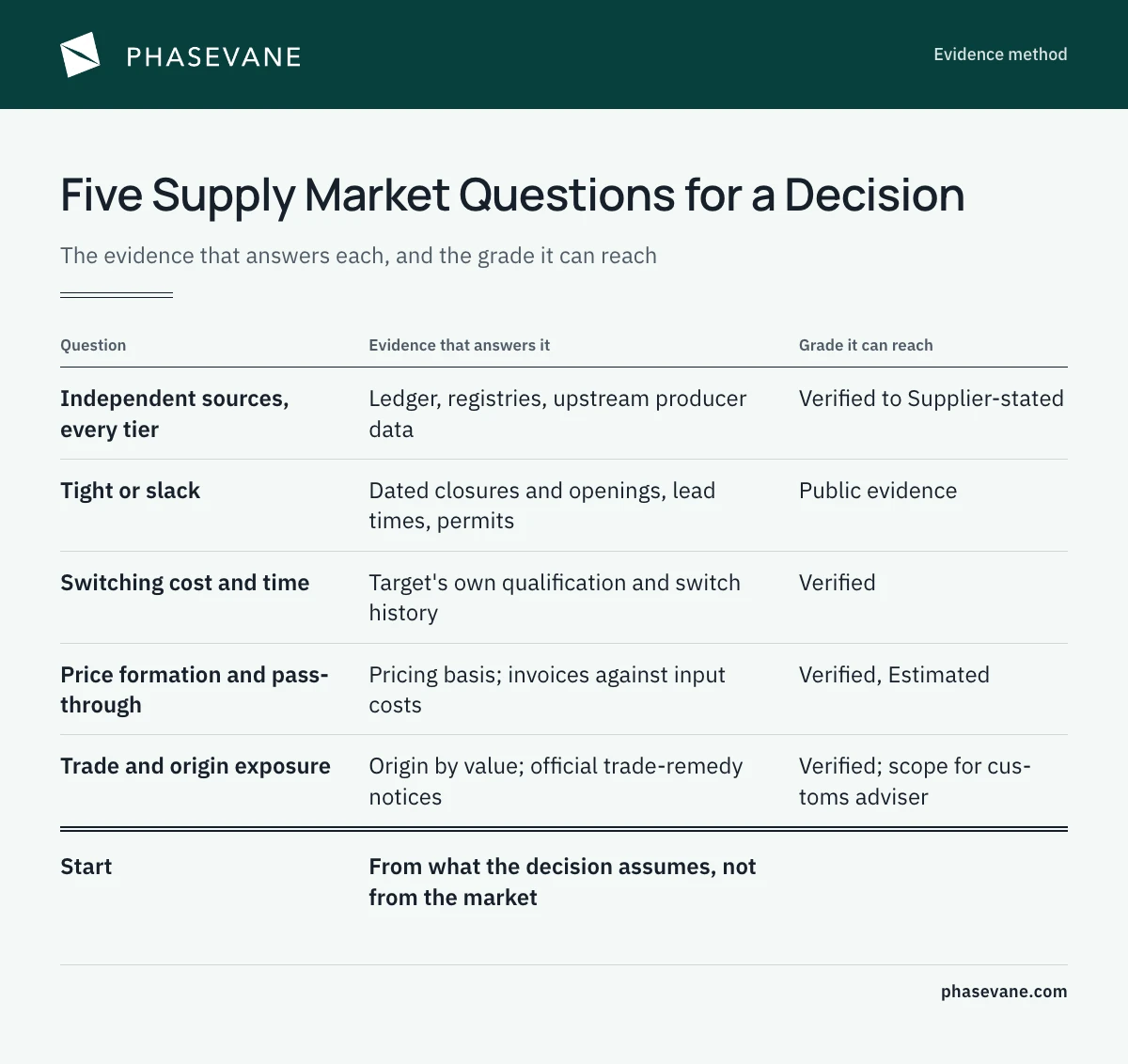 *The questions that usually decide the case, with the evidence for each.*
1. How many independent sources are there, at every tier? Count suppliers that can make the input to the required specification, then remove duplicates: trading companies that resell the same factory, sister companies under one owner, and suppliers that all buy from one upstream producer. Registry extracts settle ownership (bearing in mind that a register shows what was filed: Companies House states it does not check the accuracy of filings, S2). Our research on supplier market depth sets out the worksheet.
2. Is the market tight or slack? Look for evidence of capacity relative to demand: announced closures and openings with dates, lead times quoted now against a year ago, allocation letters. Announcements are Supplier-stated; dated permits and filed accounts are Public evidence. Capacity claims for a specific supplier need the four-number test in manufacturing capacity claims.
3. What does switching cost, and how long does it take? The question is not whether other suppliers exist but whether the target (or its customers) can move to them: requalification, tooling, certification, customer approval. The target's own history of switching is the best evidence, and it sits in its records.
4. How are prices formed and passed through? Is the input priced off an index, negotiated annually, or set by a dominant producer? And separately: does the target recover increases from its own customers, how fast, and how completely? The second half is answered by the target's invoices, not by the market.
5. How exposed is supply to trade measures and origin? Where is the input made, by country of origin, and are there trade-remedy measures or investigations on it? Official notices settle what exists; whether a product falls within scope is for a customs adviser. Public trade statistics help with origin patterns, within limits explained in trade data for supplier research.
A worked read
Fund G is considering Company J, a UK maker of food-grade plastic containers. The investment paper says: "Resin supply is secure: three qualified suppliers, and price movements are passed through within a quarter."
Question 1: independent sources. The target's approved supplier list and purchase ledger (Verified) show three resin suppliers. Supplier declarations and the suppliers' own published product data (Supplier-stated) indicate that two of the three distribute the same producer's food-grade resin. At the upstream tier, there are two independent sources, not three. Status: holds at the supplier tier; not at the producer tier.
Question 3: switching. Company J's quality records (Verified) show that its last change of resin grade, in 2024, needed customer approval and took five months from first trial to full production. A third upstream source exists in the market but is not qualified; switching to it would take months, not weeks.
Question 4: pass-through. Resin is about 45% of Company J's cost of goods, which were GBP 12.0 million in FY26: about 0.45 x 12.0 = GBP 5.4 million a year. Comparing invoice prices with resin costs over the last three increases (Estimated from invoice and purchase records), Company J recovered about 70% of each increase within two quarters. For a 10% resin rise, that is GBP 0.54 million of extra cost a year. At 70% recovery, about 0.54 x 0.30 = GBP 0.16 million a year stays in Company J's costs, and more than that share in the first two quarters while prices catch up.
| Element | Reading |
|---|---|
| Claim | "Three qualified suppliers, and price movements are passed through within a quarter" |
| Status | Holds in part. Three suppliers, two upstream sources. Pass-through is partial (about 70%) and takes up to two quarters |
| Confidence | Moderate. Supplier count, switching history and invoices are Verified; the shared upstream producer rests on supplier statements; pass-through is an estimate from three episodes |
| Commercial implication | A disruption at the shared producer would reach two of three suppliers. Margin absorbs roughly 30% of a resin rise, and more while prices catch up over two quarters |
| Action | Test. Ask for resin purchases by producer, not by distributor; model pass-through at 70% over two quarters; put qualification of the third upstream source in the 100-day plan |
The market report would have said, correctly, that the resin market has several producers. The decision analysis says that this target depends on two of them, and that its pass-through is slower and less complete than the paper states.
What to leave out
A decision analysis does not need a market forecast unless the decision depends on one, a profile of every producer, or a chart of global capacity. If the decision is whether to enter or develop a new sourcing market, that is a different question; see sourcing market feasibility. If the decision is whether to rely on a target's own supply claims, the eight-claim frame in supply chain due diligence in an acquisition applies, and this analysis supplies the market context around it.
Grade each answer as you go, using evidence grading. The UK intelligence community's published guidance describes confidence partly in terms of complexity and volatility, how quickly a situation is changing (S1). Supply markets can change quickly, so date every reading and say which answers are most likely to move.
See it applied
The sample Decision Brief applies the same method to eight supply claims for a sample furniture importer, including concentration by owner, origin by value and capacity commitments. Read the sample Decision Brief.
For your own decision, a PhaseVane Decision Brief tests the supply assumptions that move the case against public evidence and the target's records under NDA, in five working days, from GBP 3,500: commission a Decision Brief on the supply questions that move your case.
Sources (checked 8 October 2026): Explaining Uncertainty in UK Intelligence Assessment, GOV.UK, https://www.gov.uk/government/publications/explaining-uncertainty-in-uk-intelligence-assessment/explaining-uncertainty-in-uk-intelligence-assessment; Companies House search service, https://find-and-update.company-information.service.gov.uk/.
Related Research
See all research notesTopic: Supply Market Analysis
Evidence Grading: How Much Weight Can a Claim Bear?
An evidence grading system for deal and commercial decisions: six grades, confidence ceiling rules, and what to borrow from UK intelligence assessment.
Evidence GradingRead MoreCommercial Due Diligence: Which Claims Hold Up?
Commercial due diligence for deal teams: the claims it must test, the evidence that settles each, and how to state confidence and gaps before the IC.
Commercial Due DiligenceRead MoreContradictions in Due Diligence Evidence: What If Two Sources Disagree?
What to do when due diligence sources disagree: two kinds of contradiction, six usual causes, and how each changes status and confidence. Example case.
Testing ClaimsRead More