
Evidence Grading: How Much Weight Can a Claim Bear?
An evidence grading system for deal and commercial decisions: six grades, confidence ceiling rules, and what to borrow from UK intelligence assessment.
On This Page
A committee paper says the target's supply base is diversified, its key contract has been renewed and its capacity is secured. A reader cannot tell which of those statements rests on a signed document, which on a public article, and which on something the target's managing director said in a meeting. All three are written in the same confident voice.
Evidence grading fixes that. This page sets out an evidence grading system built for commercial decisions: six grades, the confidence each allows, and the rules that turn grades into a confidence level a reader can test. It also shows what commercial teams can borrow from the UK intelligence community's published approach to uncertainty, and what they should leave behind.
In short
- Grade the evidence for one statement at a time. Never grade a company, an adviser or a market.
- Six grades cover commercial work: Verified, Public evidence, Supplier-stated, Estimated, Hypothesis and Unknown.
- Each grade allows a highest confidence. The weakest critical grade sets the ceiling for the conclusion; a material unknown caps it; an open disagreement between sources lowers it.
- Confidence (how much weight a reading will bear) is not probability (how likely something is). Keep them apart.
- The UK Professional Head of Intelligence Assessment publishes both a probability yardstick and a High, Moderate, Low confidence framework. The confidence half adapts well to commercial work.
- State confidence in words with one sentence of reason. Never as a percentage.
Why commercial claims need their own grading
Look for an evidence grading system and you will find good ones built for other jobs. Clinical systems grade studies of treatments. Police and intelligence systems grade informants and intercepts. Academic work grades research designs. None of them is built for the sentence a deal team has to test: "No single supplier accounts for more than 15% of purchases."
Commercial claims have three features those systems do not handle well. The person making the claim usually holds the best evidence and has an interest in the answer. The evidence is often a business record (a ledger, a contract, a customs declaration) rather than a study or a report. And the decision has a deadline, so the question is not "what is true?" but "how much weight can this reading bear by Thursday?"
The six grades
A grade describes the evidence for one exact statement. The same document can earn different grades for different statements: a signed supply agreement is Verified for its price terms and says nothing about the supplier's capacity.
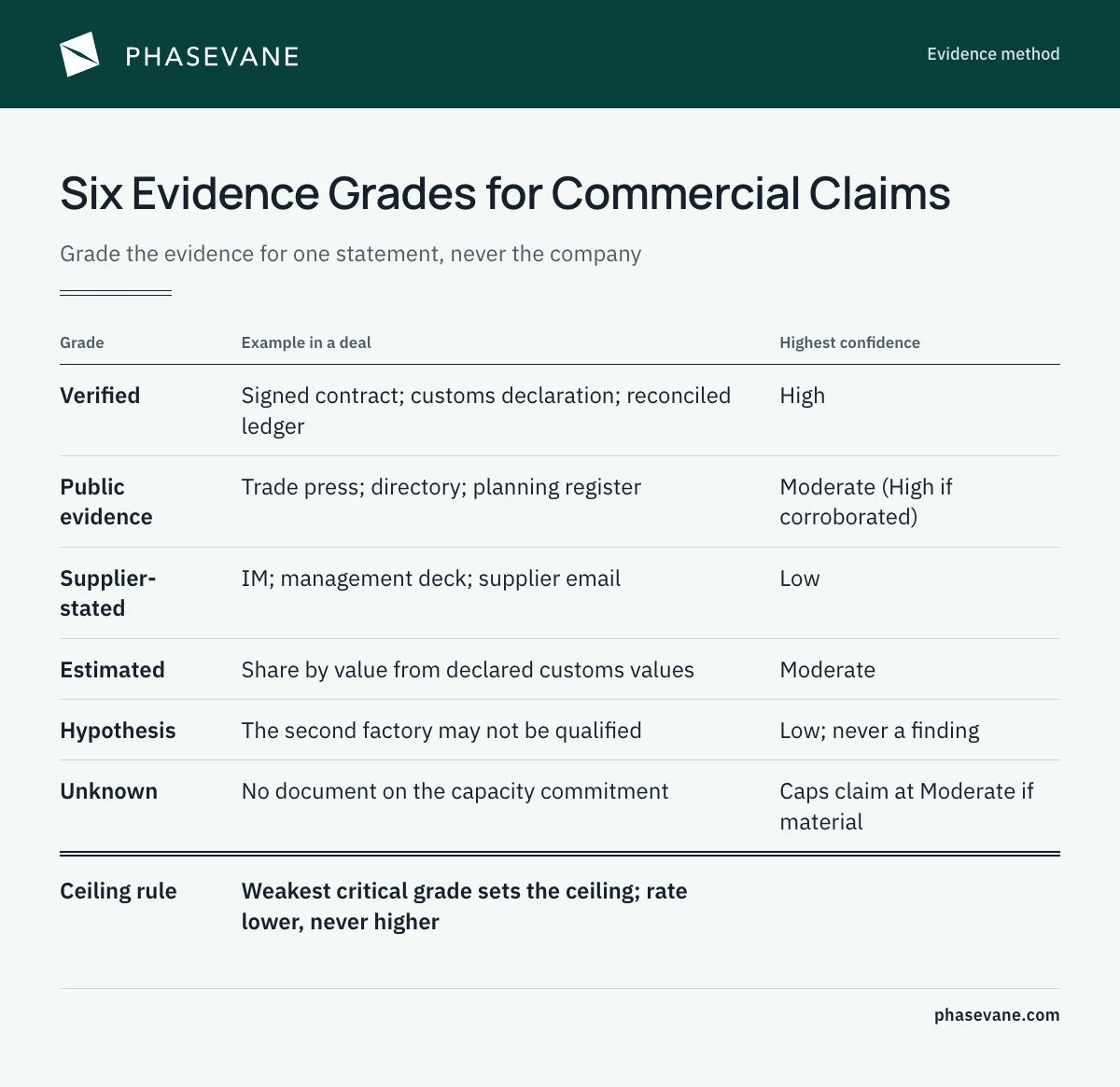 *The six grades, a commercial example of each, and the highest confidence each allows.*
| Grade | Meaning | Example in a deal | Highest confidence on its own |
|---|---|---|---|
| Verified | An authoritative record supports this exact statement | Signed contract; customs declaration; ledger reconciled to audited accounts | High |
| Public evidence | A traceable public source, below the verified standard | Trade press; directory listing; planning register | Moderate (High if independently corroborated) |
| Supplier-stated | The company or its supplier says it about itself | Information memorandum; management presentation; supplier email | Low |
| Estimated | Calculated from stated inputs, which are shown | Share by value from declared customs values | Moderate |
| Hypothesis | A proposition worth testing | "The second factory may not be qualified" | Low; never a finding |
| Unknown | The evidence does not support a conclusion | No document on capacity commitment | Caps the claim at Moderate if material |
Three points stop most grading errors.
Supplier-stated is not an accusation. Most management statements are true. The grade records who is speaking and what interest they have, not whether they are honest.
Official is not the same as verified. An official register proves what was filed. Companies House, for example, states on its search service that it does not check the accuracy of the information filed (S2). A registry extract is strong evidence of ownership as declared, and the grade should say exactly that.
Repeats count once. Ten articles that rewrite one press release are one source, and that source is the company. Trace each source to its original before counting corroboration.
Two questions for every source
Before grading, ask two separate questions of each source. Is it reliable: does it have a track record, is it independent of the claim, would it be in a position to know? Is the information credible: is it confirmed elsewhere, plausible, consistent with other records?
Keep them separate. A reliable source can be wrong on one detail, and an unreliable one can be right. A supplier's own production report (low independence) whose figures match the buyer's goods receipts (independent confirmation) is more credible than its source alone suggests.
From grades to confidence: the ceiling rules
Confidence should come from rules a reader can check, not from how the analyst feels about the target. PhaseVane uses four.
- The weakest critical grade sets the ceiling. A statement is critical if the conclusion would change were it wrong. Verified allows High; Public evidence or an estimate allows Moderate (High for public evidence independently corroborated); Supplier-stated allows Low.
- A material unknown caps confidence at Moderate.
- Each open disagreement between two sources lowers confidence one level until it is explained. A claim that disagrees with the evidence is different: that is the finding, and it does not lower confidence. The procedure is in contradictions in due diligence evidence.
- The analyst may rate lower than the ceiling, never higher.
A worked ceiling
Company T's management presentation says: "Our two largest suppliers have both renewed on three-year terms."
| Statement | Critical? | Evidence | Grade |
|---|---|---|---|
| Supplier X renewed for three years | Yes | Signed agreement in the data room, dated and countersigned | Verified |
| Supplier Y renewed for three years | Yes | Unsigned draft agreement; email from Y: "we agree the terms" | Supplier-stated |
| Prices are unchanged on renewal | No | Comparison of old and new price schedules for X | Estimated |
The weakest critical grade is Supplier-stated, so the ceiling for the claim is Low. There is also a disagreement: the draft for Y says two years, the email refers to the three-year proposal. That is an open contradiction between two sources, which would lower confidence by one level, but Low is already the floor. The finding reads: holds for X; not established for Y; confidence Low, because the Y renewal rests on an unsigned draft that gives a different term. Action: test. Ask for the signed Y agreement before signing.
The confidence is Low even though half the claim is fully verified. That is the rule working: the committee is relying on both renewals, and one of them is not yet a fact.
What to borrow from intelligence assessment
The UK's Professional Head of Intelligence Assessment (PHIA) publishes how the intelligence community communicates uncertainty (S1). It uses two frameworks for two different things.
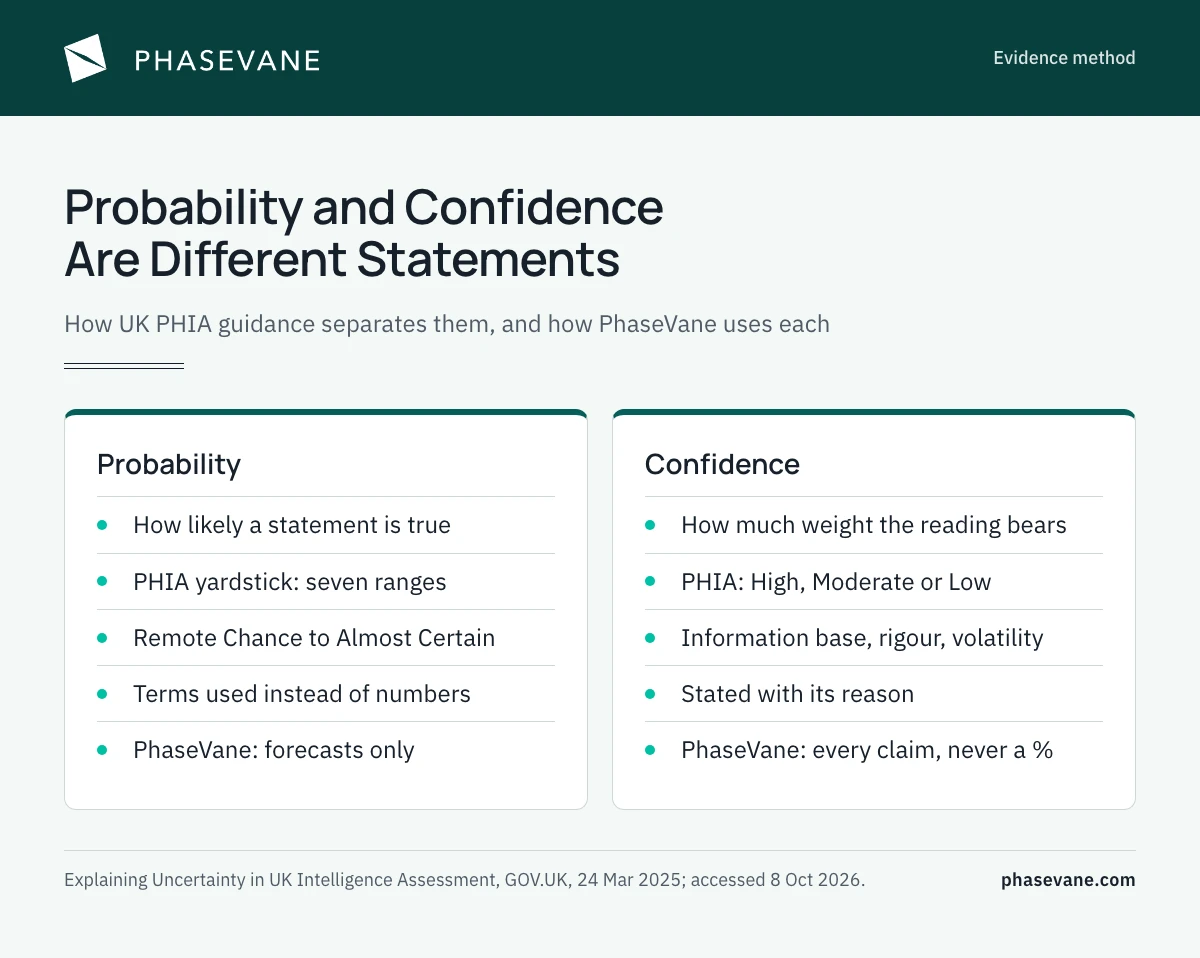 *Probability and confidence answer different questions. Source: PHIA guidance on GOV.UK (S1).*
The Probability Yardstick describes how likely a statement is to be true or an event to happen, using set terms for seven ranges, from Remote Chance (above 0% to about 5%) to Almost Certain (about 95% to just under 100%) (S1). The guidance explains that terms are used instead of numbers to avoid judgements being read as more precise than they are.
Analytical Confidence Ratings describe the soundness and stability of the foundations on which a likelihood judgement is made. There are three ratings, High, Moderate and Low, informed by an evaluation across three categories: Information Base, Analytical Rigour, and Complexity and Volatility (S1).
The confidence framework maps cleanly onto commercial evidence work:
| PHIA category | Commercial equivalent | How it shows up in a Decision Brief |
|---|---|---|
| Information Base | What records exist, and how good they are | The six grades, and the ceiling from the weakest critical grade |
| Analytical Rigour | How the evidence was handled | Claims split into statements; sources traced to originals; contradictions logged and explained |
| Complexity and Volatility | How fast the answer could change | Timing tests: a supplier email can be overtaken next month; a signed reservation cannot |
PhaseVane borrows the separation and the categories. It does not claim to use the PHIA tool, and its ceiling rules are its own.
Where probability language helps, and where it misleads
Most claims a deal team tests are about the present or the past: who owns a supplier, what a contract says, what share of purchases came from Vietnam last year. Those statements are either true or not, and the useful output is a status (holds, holds in part, not established, does not hold as stated) with a confidence level. Attaching a probability to them adds false precision.
Forward-looking questions are different. "Will the new line open before the plan year ends?" is a forecast. If your committee wants likelihood language for forecasts, adopt a yardstick, write its ranges into the paper, and use only its terms. Do not mix in "possible", "probable" and "likely" with private meanings. And never present confidence itself as a percentage: "70% confident" invites a debate about the number instead of the evidence.
Five grading mistakes
- Grading the document, not the statement. A data-room spreadsheet is not "Verified" as a whole. Its totals may reconcile to the accounts while its supplier names, country codes or ownership notes were typed in by someone with no record behind them. Grade each column you rely on.
- Upgrading by volume. Three management slides, an email and a website page saying the same thing are still Supplier-stated. Quantity of repetition is not independence.
- Downgrading the finding instead of the evidence. When a claim fails on a signed contract, the finding is strong. Confidence stays High; the status changes.
- Letting the conclusion set the grade. If a source is graded higher because it supports the case, or lower because it does not, the grading has stopped working. Grade sources before reading what they imply.
- Leaving Unknown blank. "Not verified" tells the committee nothing. "Unknown: whether the second factory is approved for these 22 products; would settle it: approved pre-production samples; held by the head of quality" tells it what to ask for.
Grading in practice
- Grade at the row level. Each source in the evidence register gets a grade for the statement it supports, with the date opened and an archive copy. The PhaseVane methodology describes the register.
- Open every source. If an AI tool found it, a person still opens it, locates the sentence or figure, and archives it before it is cited. A source that cannot be found becomes an Unknown.
- Write the reason sentence. "Moderate: purchase orders reconciled to the ledger are strong; whether the second factories are qualified is unknown." The sentence is what a committee member can challenge.
- Name what would settle each unknown, and who holds it. That turns a gap into a management question.
- Know when documents will not reach. Behaviour and intent often need conversations; see when desk research is enough.
The broader test of whether evidence supports a decision is in commercial evidence quality: a practical test. The grades are applied claim by claim in commercial due diligence, and reported to the committee using the decision memo template.
Use the system yourself
When the committee will ask who checked the evidence, and the team is already on the model and the documents, a PhaseVane Decision Brief applies the same grades as an independent reader, from GBP 3,500: commission a graded Decision Brief.
Sources (checked 8 October 2026): Explaining Uncertainty in UK Intelligence Assessment, GOV.UK (published 24 March 2025), https://www.gov.uk/government/publications/explaining-uncertainty-in-uk-intelligence-assessment/explaining-uncertainty-in-uk-intelligence-assessment; Companies House search service, https://find-and-update.company-information.service.gov.uk/.
Related Research
See all research notesTopic: Evidence Grading
Supply Market Analysis for a Decision: Which Assumptions Hold?
Supply market analysis that answers an investment or strategy decision: five questions, the evidence for each, and a sample worked read on resin supply.
Supply Market AnalysisRead MoreCommercial Due Diligence: Which Claims Hold Up?
Commercial due diligence for deal teams: the claims it must test, the evidence that settles each, and how to state confidence and gaps before the IC.
Commercial Due DiligenceRead MoreContradictions in Due Diligence Evidence: What If Two Sources Disagree?
What to do when due diligence sources disagree: two kinds of contradiction, six usual causes, and how each changes status and confidence. Example case.
Testing ClaimsRead More