
Red Flag Due Diligence Report or Decision Brief: Which Does Your Deal Need?
Red flag due diligence report or graded decision brief? What each answers, what silence means, and why a commercial red flag needs an evidence grade.
On This Page
You need to know, fast, whether anything in the target should stop the deal or change the price. One adviser offers a red flag due diligence report. Another approach is a decision brief: fewer topics, each claim graded and given a confidence level. They are not two sizes of the same product. They answer different questions, and the difference matters most in what each one's silence means.
This comparison sets out what each format is for, where each fails, and how to use them in sequence. It also shows why a commercial red flag without an evidence grade can mislead a committee in both directions.
In short
- A red flag report looks for exceptions across a broad scope and reports only what it finds. It is fast and useful early.
- A decision brief starts from one decision and tests the specific claims that carry it, each graded, with confidence, contradictions and an action.
- In a red flag report, no flag means nothing was found in the time and scope available. It does not mean the claim was tested and holds.
- A flag colour without an evidence grade hides the most important fact: whether the problem is confirmed or alleged.
- Use a red flag scan to decide whether to proceed and what to test. Use a decision brief on the claims that carry the price before the committee.
Side by side
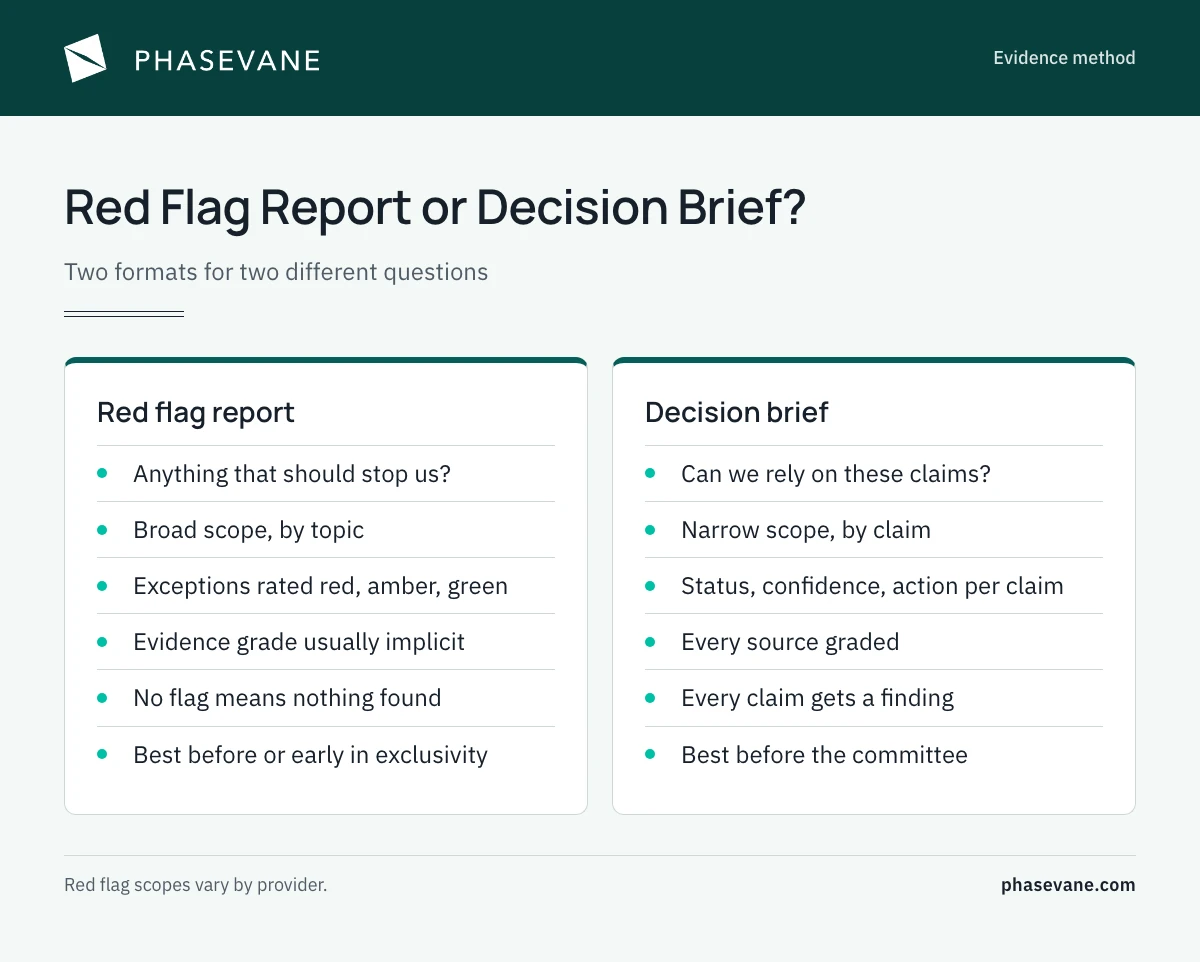 *Two formats for two questions.*
| Red flag report | Decision brief | |
|---|---|---|
| The question | Is there anything here that should stop us or change the terms? | Can we rely on these specific claims for this decision? |
| Unit of analysis | Topic or document area | One claim, split into testable statements |
| Scope | Broad: legal, financial, commercial, tax, often several advisers | Narrow: the claims that carry the price |
| Output | A list of exceptions, often rated red, amber, green | Status, confidence and action per claim |
| Evidence grading | Usually implicit | Explicit, per source |
| Contradictions | Reported if material | Kept beside the conclusion they affect |
| What silence means | Nothing found in the time and scope | Not applicable: every claim in scope gets a finding, including Unknown |
| Best stage | Before exclusivity or early in it | Before the investment committee |
Neither is better in general. A red flag scan that finds a title defect in week one saves a full diligence budget. A graded brief that shows supplier concentration is twice what the information memorandum (IM) claims changes the warranty and maybe the price.
The problem with a flag colour on its own
A red flag report rates issues. It rarely says how strong the evidence behind each rating is. That matters because the same colour can mean opposite things.
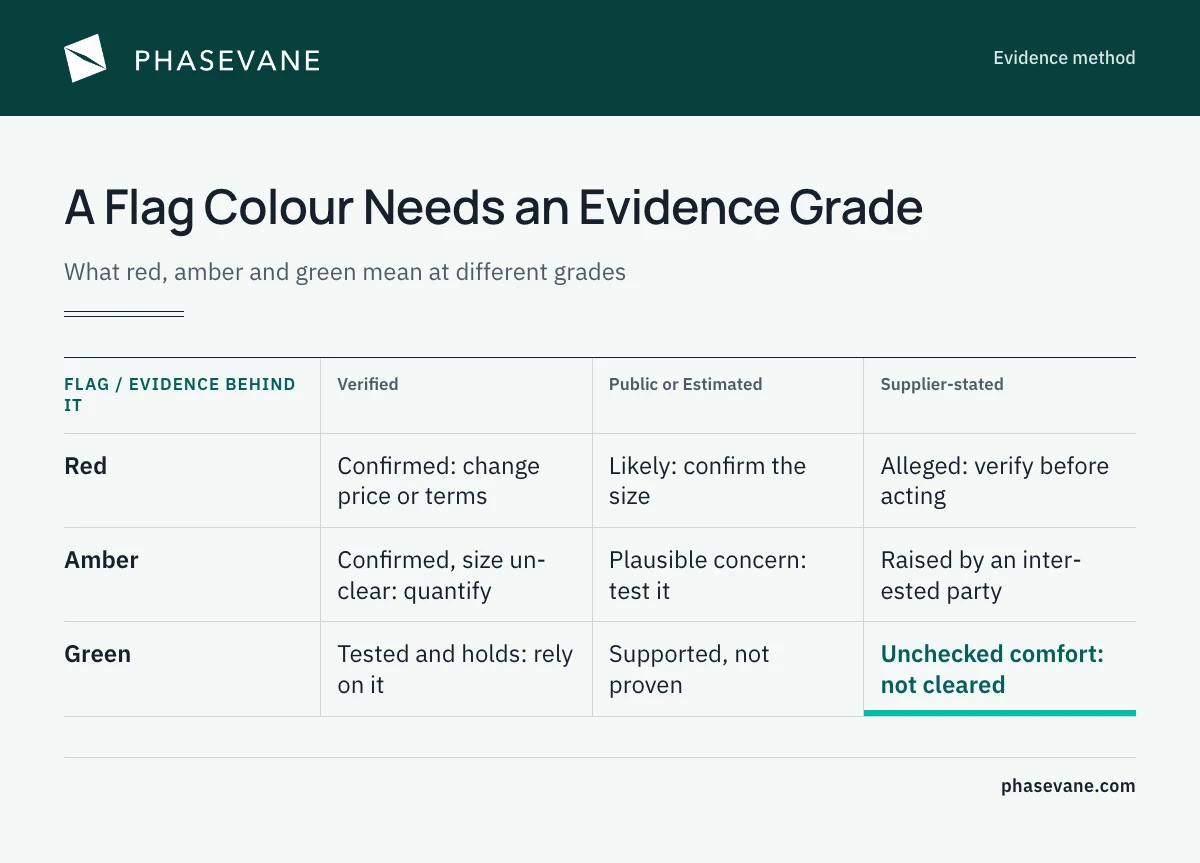 *A flag colour means different things at different evidence grades.*
| Flag | On Verified evidence | On Supplier-stated evidence |
|---|---|---|
| Red | Problem confirmed: change the price or terms | Problem alleged: verify before acting |
| Amber | Confirmed issue of uncertain size: quantify it | Concern raised by an interested party: test it |
| Green | Tested and holds: rely on it | Unchecked comfort: not a clearance |
The bottom right cell is where deals get hurt. "Supplier relationships: green" on the strength of a management interview is not the same as green on the strength of supply agreements and a reconciled purchase ledger. The grades that make the difference visible are explained in evidence grading.
One commercial red flag, rewritten
A red flag report on Company P, a UK maker of laboratory consumables, contains this line:
Customer concentration: AMBER. Top customer approximately 18% of revenue per management. Recommend further review.
Rewritten as a graded finding, after reading the ledger and contracts:
| Element | Reading |
|---|---|
| Claim | "Our largest customer is 18% of revenue" (management meeting) |
| Evidence | Revenue ledger reconciled to accounts (Verified): largest account 17.6%; a second account under the same parent adds 6.1% |
| Status | Holds by account; by owner the customer group is 23.7% |
| Confidence | High: ledger and registry records agree; no open contradiction |
| Commercial implication | One buying decision covers nearly a quarter of revenue; contract allows six months' notice |
| Action | Test: ask for the customer's tender timetable; model a downside; ask counsel about warranty wording |
The amber flag was not wrong. It was incomplete in two ways the committee needed: the concentration was larger than stated, and the confidence was high. "Recommend further review" became a specific question and a specific model change. Grouping customers by owner is worked through in customer concentration thresholds, and the wider claim list in commercial due diligence.
Where each format fails
Red flag reports fail when silence is read as clearance, when the colour hides the evidence grade, and when "recommend further review" is the end of the line rather than the start of a scope.
Decision briefs fail when the decision is not yet defined (too early to know which claims matter), when the scope is too wide to grade properly in the time, or when the claims need evidence that only interviews or site work can reach. A good brief says so and names who should look.
Using them in sequence
- Before or at the start of exclusivity: a red flag scan across the broad scope. Its job is to stop a bad deal early and to tell you which claims deserve real testing.
- During exclusivity: list the claims the price depends on, using the flags and the IM; see testing management presentation claims.
- Before the committee: a decision brief on those claims, each with status, confidence and action, summarised in the decision memo template.
If you are briefing either kind of work, the questions in how to brief commissioned research apply to both: state the decision, the deadline, the claims and what you will do with each answer.
The UK intelligence community describes confidence as the soundness and stability of a judgement's foundations (S1). A flag colour tells the committee what was found. The grade and the confidence tell it how much weight the finding can bear.
See the decision format
The sample Decision Brief shows the format on eight supply claims for a sample target: each claim quoted, graded, given a status, a confidence level and an action, with three items to close before signing. See the sample.
When the red flags are in and the committee date is set, a PhaseVane Decision Brief tests up to eight claims that carry the price, in five working days, from GBP 3,500: commission a Decision Brief.
Sources (checked 8 October 2026): Explaining Uncertainty in UK Intelligence Assessment, GOV.UK, https://www.gov.uk/government/publications/explaining-uncertainty-in-uk-intelligence-assessment/explaining-uncertainty-in-uk-intelligence-assessment.
Related Research
See all research notesTopic: Decision Outputs
Decision Memo Template for Deal Teams: What Does the Committee Need to See?
A two-page decision memo template for investment committees: decision, position, claims with status and confidence, gaps. Filled example example.
Decision OutputsRead MoreSupply Market Analysis for a Decision: Which Assumptions Hold?
Supply market analysis that answers an investment or strategy decision: five questions, the evidence for each, and a sample worked read on resin supply.
Supply Market AnalysisRead MoreEvidence Grading: How Much Weight Can a Claim Bear?
An evidence grading system for deal and commercial decisions: six grades, confidence ceiling rules, and what to borrow from UK intelligence assessment.
Evidence GradingRead More