
Management Presentation Claims: Which Ones Should You Test First?
Test supply claims in a management presentation before they enter the model: sort, split, triage by price impact, then grade. Annotated example slide.
On This Page
The management presentation went well. Slide 12 covers the supply chain in seven confident lines, and every one of them is now somewhere in your model: margin, stock cover, growth capacity, the absence of a tariff discount. The investment committee meets in a week. You cannot test everything, and you should not try.
This guide shows how to test management presentation claims about the supply base in the time a deal actually allows. It works through one annotated example slide: how to sort its claims, split each into statements that can be tested, pick the few that carry the price, and decide what evidence would settle them before anyone starts reading.
In short
- Sort every claim first: a fact about the past or present, a forecast, an opinion, or a fact that depends on a definition management chose.
- Split each testable claim into the statements that would all have to be true. The claim often holds for one and fails for another.
- Triage by two questions: does the price move if this is wrong, and can evidence reach it this week? Test the claims that score high on both.
- Name the settling evidence before you research. It turns a vague request into a named document.
- For forecasts, test the basis (a contract, an order, a permit), not the forecast.
- Write each finding with a status, a confidence level and an action. Management questions come from the gaps.
The slide
Company R is a UK distributor of branded kitchenware. This is slide 12 of its management presentation.
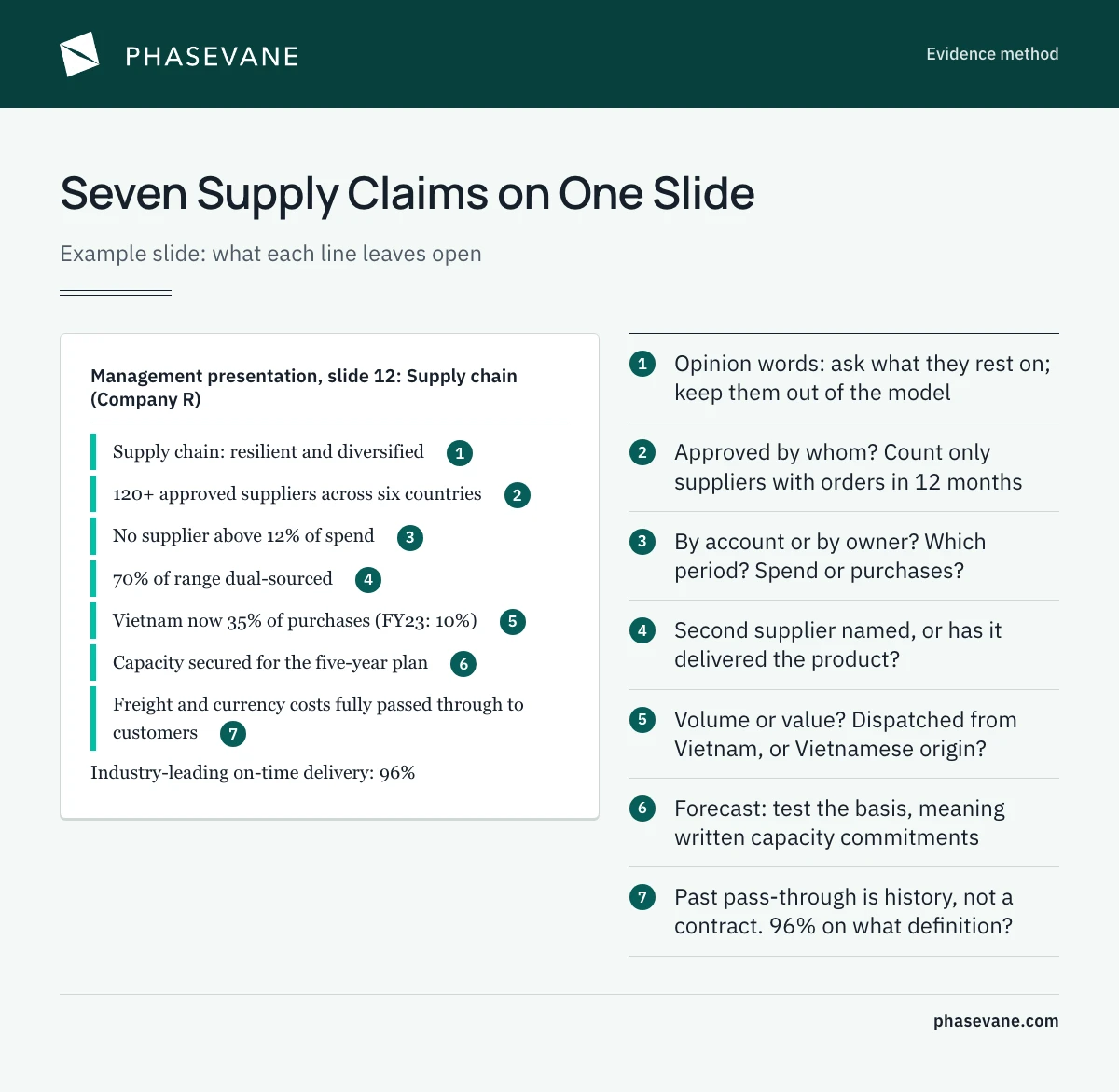 *Seven supply claims and the question each leaves open.*
Supply chain: resilient and diversified
- 120+ approved suppliers across six countries
- No supplier above 12% of spend
- 70% of range dual-sourced
- Vietnam now 35% of purchases (FY23: 10%)
- Capacity secured for the five-year plan
- Freight and currency costs fully passed through to customers
- Industry-leading on-time delivery: 96%
Every line is plausible. Several are probably true on the definition management used. The work is to find the definition, and then the evidence.
Step 1: sort the claims
| Type | Lines on the slide | How to treat it |
|---|---|---|
| Fact about the past or present, definition clear | 6, read as history only (see below) | Test directly |
| Fact that depends on a definition | 1, 2, 3, 4, 7 | Ask for the definition first; test on yours and on theirs |
| Forecast | 5 | Test the basis: written reservations, orders, permits |
| Opinion or superlative | "Resilient", "diversified", "industry-leading" | Not testable as worded. Ask what it rests on; do not put it in the model |
Line 6 is a fact about the past ("passed through") that is easy to over-read as a promise about the future. Test the history, and note that the history is not a contract.
Step 2: split each claim into statements
A claim is usually several statements joined together. Write each one so a single document could confirm or contradict it.
- Line 2, "No supplier above 12% of spend": the largest supplier account is at or below 12% of purchases in a stated period; no group of commonly owned suppliers exceeds 12%.
- Line 3, "70% of range dual-sourced": 70% of products (by count? by revenue?) have two suppliers that have both delivered them in the last 24 months; both are approved for that exact product.
- Line 4, "Vietnam now 35% of purchases": Vietnam share is 35% on a stated measure (value or volume) and period; the goods are of Vietnamese origin, not only shipped from there.
- Line 5, "Capacity secured": written commitments exist for the volumes in the plan, for the years in the plan.
Splitting does two jobs. It shows where the claim is most likely to fail, and it tells you which document to ask for. The supply versions of these splits are set out claim by claim in supply chain due diligence in an acquisition.
Step 3: triage by price impact and evidence reach
You have a week. Put each claim on two scales: how much the price, debt case or plan moves if it is wrong, and whether the evidence that would settle it can be reached in that time.
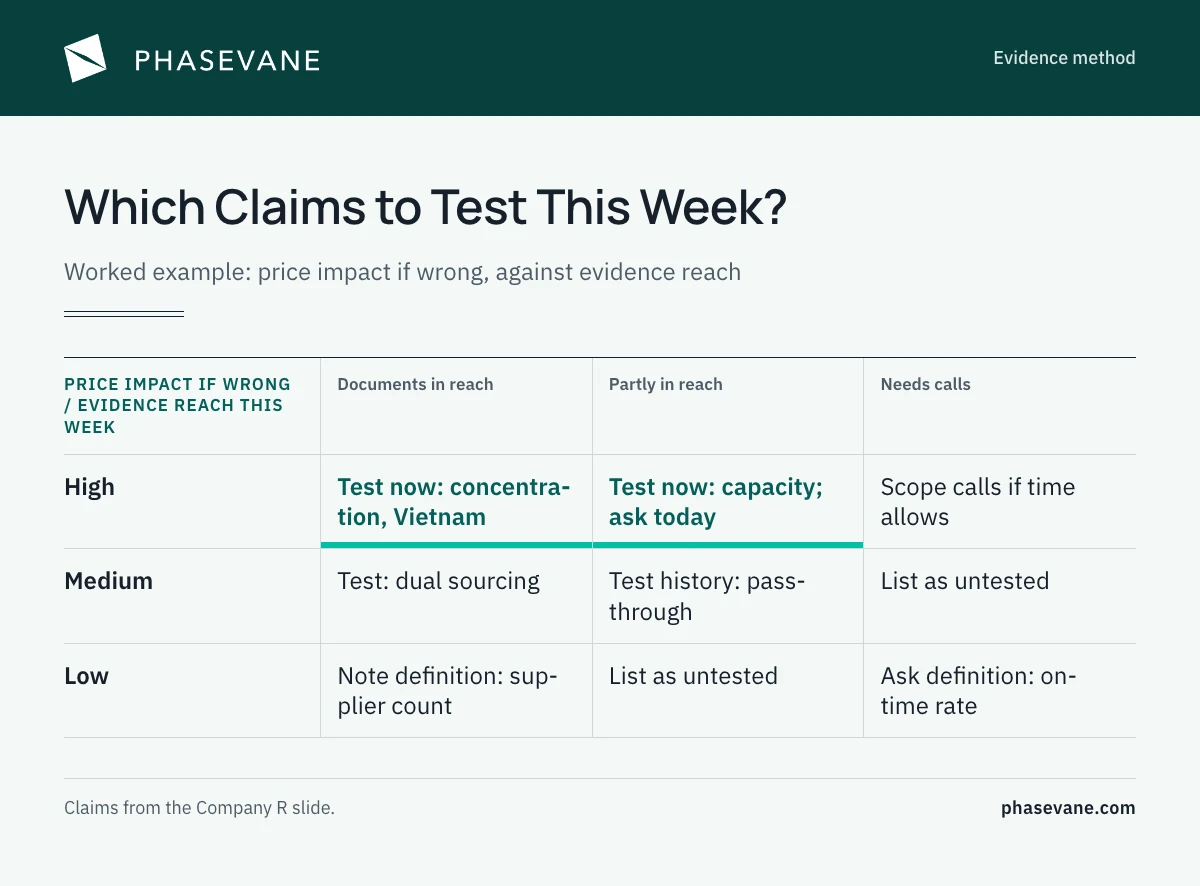 *Test now where impact is high and documents can reach it.*
| Line | If wrong, what moves | Evidence reach this week | Decision |
|---|---|---|---|
| 2 Concentration | Warranty wording; risk discount | Purchase ledger and registry extracts: high | Test now |
| 4 Vietnam share | Tariff exposure in the margin bridge | Customs declarations, ledger by origin: high | Test now |
| 5 Capacity | Growth line in the base case | Supply agreements; reservations if they exist: medium | Test now; ask for the documents today |
| 3 Dual sourcing | 100-day plan cost | Purchase orders by product and supplier: high | Test if time allows |
| 6 Pass-through | Gross margin sensitivity | Invoice price history: medium | Test history; flag that it is not a contract |
| 1 Supplier count | Little on its own | Active supplier list: high | Note the definition; do not spend time |
| 7 On-time delivery | Customer narrative | Depends on definition; customers hold the best evidence | Ask for the definition; consider calls later |
Three claims carry most of the value and can be reached this week. That is a scope a committee can rely on: three claims tested to a stated confidence, the rest listed with their status as untested.
Step 4: name the settling evidence before you research
For each claim in scope, write down the document that would settle it, and who holds it, before anyone opens a browser.
| Claim | Settling evidence | Who holds it |
|---|---|---|
| 2 Concentration | Purchase ledger by supplier, 24 months, reconciled to accounts; registry extracts for the top ten suppliers | Finance director; public registries |
| 4 Vietnam share | Customs declarations with origin and value; purchase value by country of origin | Customs broker; finance |
| 5 Capacity | Supply agreements; dated, volume-specific capacity confirmations | Head of buying; suppliers |
This step stops two common failures: research that answers an easier question than the one asked, and requests to management that are too vague to refuse or to fulfil. Capacity claims in particular need separating into nameplate, demonstrated, available and committed numbers; see manufacturing capacity claims.
Step 5: read, grade and log contradictions
Read each statement against its evidence and grade each source for that statement: Verified, Public evidence, Supplier-stated, Estimated, Hypothesis or Unknown. The rules for turning grades into confidence are in evidence grading.
Expect contradictions. In this example case, the ledger shows the largest supplier account at 11.4%, which supports line 2, but two accounts share a parent and together reach 19.8%. That is a claim-vs-evidence contradiction, and it is the finding. If the customs data and the forwarder's report disagree on the Vietnam share, that is a source-vs-source contradiction, and it lowers confidence until explained. The procedure is in contradictions in due diligence evidence.
Step 6: write the finding, then the questions
Each tested claim gets five lines: status, confidence with one reason, the contradiction beside it, the commercial implication, and an action (proceed, test, hold or investigate). Then convert every gap into a question for management that names the document.
Questions that produce documents:
- "Please share purchases by supplier for FY25 and FY26, reconciled to the accounts, and tell us which suppliers share an owner."
- "Please share purchase value by declared country of origin for the last 24 months."
- "Is there a written capacity commitment for the FY27 volumes? Please share it, or confirm there is none."
Questions that produce reassurance, and should be avoided: "How confident are you in the supply base?" "Any concerns about capacity?"
The UK intelligence community describes analytical confidence as reflecting the soundness and stability of the foundations of a judgement (S1). A management answer in a meeting is a foundation of the least stable kind. A document is better, and a document that reconciles to the accounts is better still.
How this fits the wider diligence
A management presentation is one source of claims; the information memorandum and the data room are others. The same sort, split and triage applies to all of them, and the claims from each family (market, position, customers, price, supply) are set out in commercial due diligence. If the slide also makes a customer claim, the grouping logic in customer concentration thresholds applies.
Have the claims tested
If one line on the slide carries the price, a Claim Check reads that claim against public evidence and anything you can share, and returns a written evidence note with status, confidence, what would settle it and the questions for management. GBP 395, three working days: send one supply claim from the presentation for a Claim Check.
If several supply claims carry it, a Supply Base Check reads up to eight against management data under NDA and delivers a Decision Brief in five working days, from GBP 3,500: have up to eight claims tested.
Sources (checked 8 October 2026): Explaining Uncertainty in UK Intelligence Assessment, GOV.UK, https://www.gov.uk/government/publications/explaining-uncertainty-in-uk-intelligence-assessment/explaining-uncertainty-in-uk-intelligence-assessment.
Related Research
See all research notesTopic: Testing Claims
Contradictions in Due Diligence Evidence: What If Two Sources Disagree?
What to do when due diligence sources disagree: two kinds of contradiction, six usual causes, and how each changes status and confidence. Example case.
Testing ClaimsRead MoreSupply Market Analysis for a Decision: Which Assumptions Hold?
Supply market analysis that answers an investment or strategy decision: five questions, the evidence for each, and a sample worked read on resin supply.
Supply Market AnalysisRead MoreEvidence Grading: How Much Weight Can a Claim Bear?
An evidence grading system for deal and commercial decisions: six grades, confidence ceiling rules, and what to borrow from UK intelligence assessment.
Evidence GradingRead More