
How to Brief Commissioned Research: Question, Scope and Budget
A one-page brief for commissioned research: the decision, the claims, the use of each answer, what you can share, scope and budget. Example example.
On This Page
You are about to commission outside research for a deal or a commercial decision. The risk is not that the provider does poor work. It is that they do good work on a question you did not need answered: a market overview when you needed three claims tested, or a long report that arrives the day after the committee.
This guide shows how to brief a commissioned research project on one page so that the answer is usable, on time and in budget. It sets out eight fields and why each matters, a rule for sizing scope and budget, a filled example brief, and what a good provider should send back before any work starts.
In short
- Start with the decision, not the topic. One sentence: what is being decided, by whom, by when.
- List the claims to be tested, quoted exactly, with where each was made.
- Say what you will do with each answer. That decides how precise it needs to be.
- Say what you can share, and under what terms. Most deal claims are settled by documents.
- Size the scope by claims, evidence reach and deadline, not by pages.
- Set the budget against what a wrong answer would move, not against what research usually costs.
- Expect a one-page scope back before work starts: what can be tested, what needs which documents, what will not be done.
The one-page brief
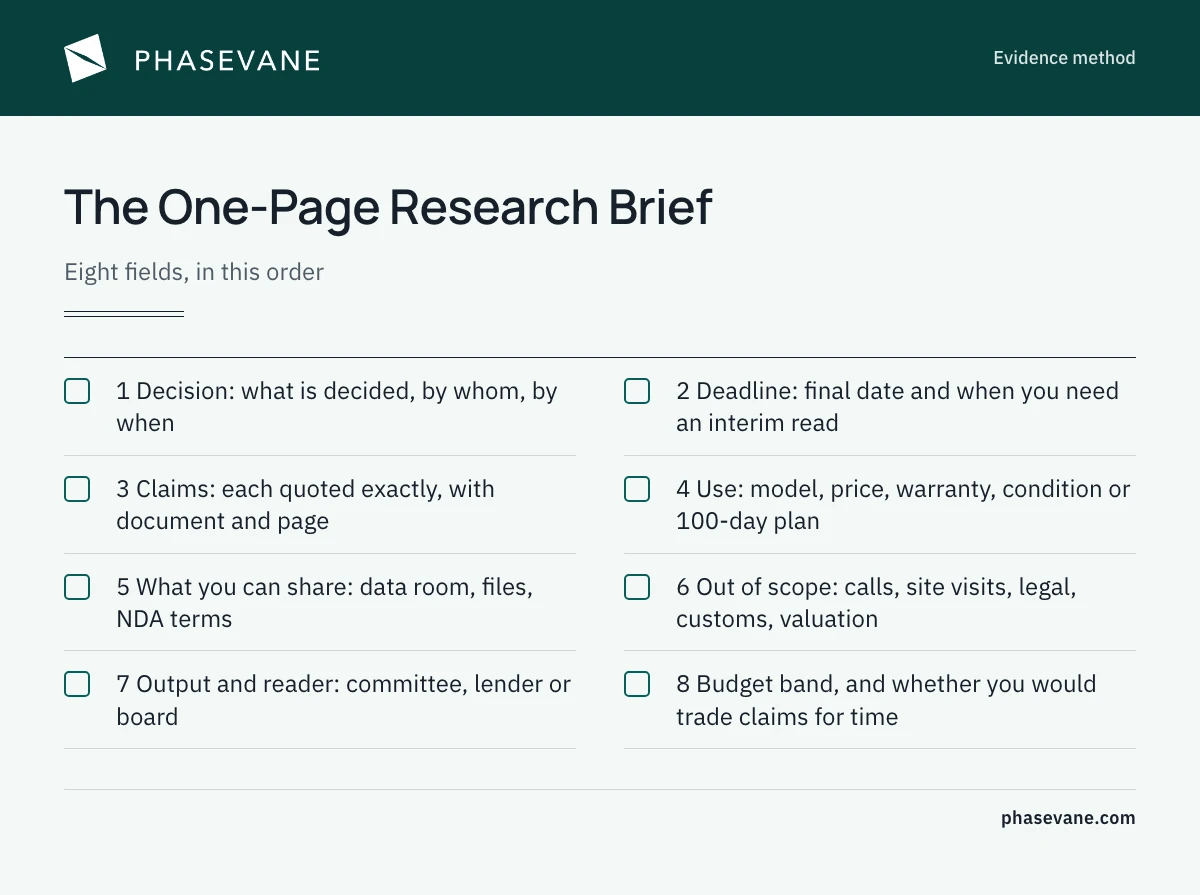 *Eight fields on one page.*
| # | Field | What to write | Why it matters |
|---|---|---|---|
| 1 | Decision | One sentence: what is decided, by whom, by when | Every claim tested must matter to it |
| 2 | Deadline | Final date, and when you need an interim read | Sets what evidence is reachable |
| 3 | Claims | Each claim quoted exactly, with document and page | Stops the provider answering an easier question |
| 4 | Use of each answer | Model, price, warranty, condition or 100-day plan | Sets the precision needed |
| 5 | What you can share | Data room access, specific files, NDA terms | Decides between Verified and Supplier-stated evidence |
| 6 | Out of scope | Calls, site visits, legal, customs, valuation | Prevents scope creep and false comfort |
| 7 | Output and reader | Committee paper, lender pack, board note; who reads it | Sets format and length |
| 8 | Budget and trade-offs | A band, and whether you would trade claims for time | Lets the provider propose a realistic scope |
Two fields do most of the work. Field 3 forces you to read the information memorandum or management presentation and pick the claims that matter; the method is in testing management presentation claims. Field 4 tells the provider whether "about a quarter" is good enough, or whether the warranty wording depends on whether it is 24% or 26%.
Sizing the scope
Scope comes from three things: how many claims, how hard the evidence is to reach, and how many days there are.
- Claims. Four to eight claims that carry the price is a normal scope for a focused brief. Twenty claims in five days means none is tested properly.
- Evidence reach. Claims settled by documents you can share are quick. Claims about behaviour or intent need calls; physical claims need site work. See when desk research is enough.
- Days. Work back from the committee date. Leave a day for your own team to read the output before the paper is due.
If the three do not fit, cut claims, not rigour. A committee is better served by five claims tested to a stated confidence and three listed as untested than by eight claims tested thinly.
Setting the budget
Most buyers set a research budget by asking what research usually costs. A better anchor is what a wrong answer would move.
Fund F's model assumes Company W's largest supplier will hold prices for 12 months. If that claim is wrong, the fund estimates EBITDA (earnings before interest, tax, depreciation and amortisation) would be about GBP 0.25 million lower. At the 6x multiple in the offer, that is 0.25 x 6 = GBP 1.5 million of value. A GBP 3,500 brief on that claim and the others alongside it costs 3,500 / 1,500,000 = about 0.23% of the value exposed on one claim alone.
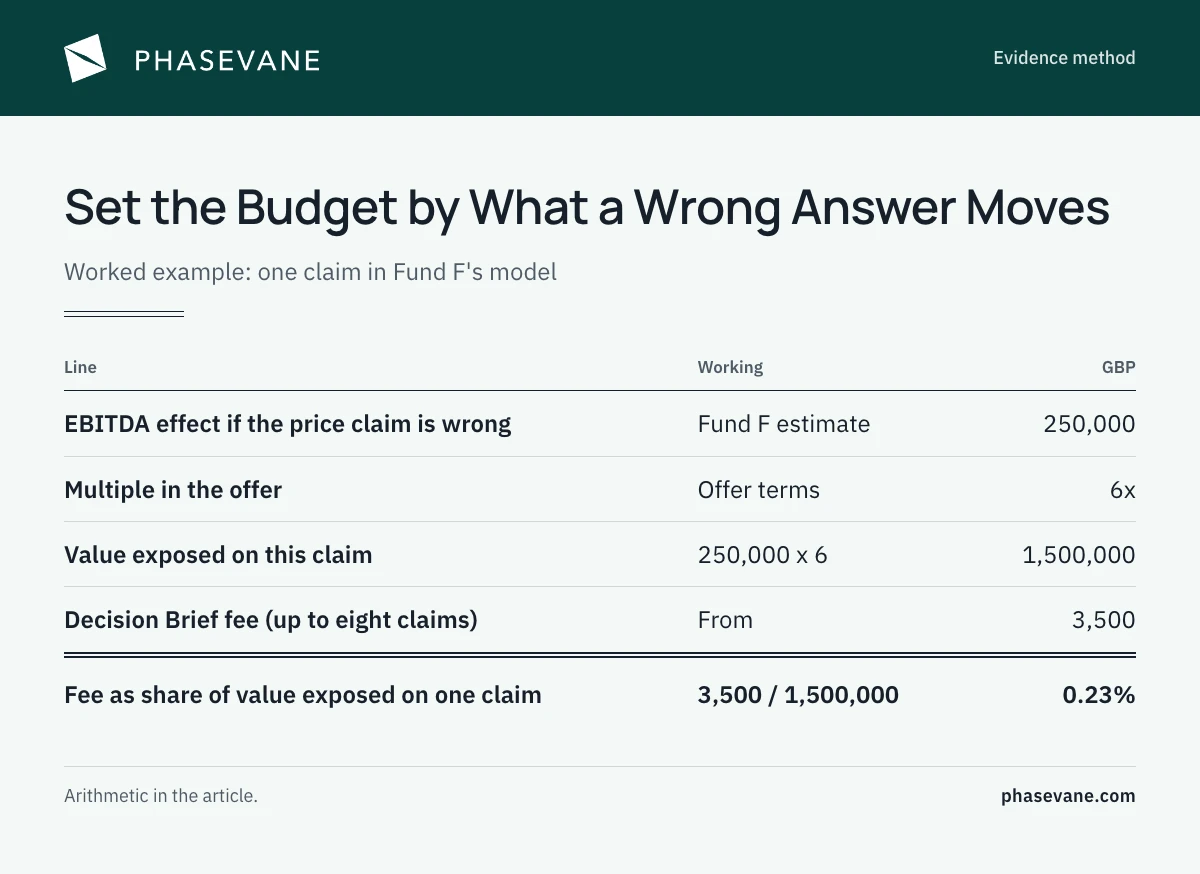 *The budget rule on one example claim.*
The rule cuts both ways. If no claim moves more than a few thousand pounds of value, you do not need outside research on it; note it as untested and move on.
A filled brief
- Decision. Should Fund F proceed to signing for Company W at GBP 9.0 million on 20 November? Investment committee, 17 November.
- Deadline. Final brief by 13 November; a call on day 3 if anything looks likely to move the price.
- Claims. C1 "Our largest supplier has fixed prices until December 2027" (IM, page 19). C2 "No supplier above 20% of purchases" (IM, page 18). C3 "All products are manufactured in the UK" (management presentation, slide 9). C4 "Capacity in place for 25% growth" (slide 11).
- Use. C1 and C4: model assumptions. C2: warranty definition. C3: customer contracts and marketing claims.
- What we can share. Data room under our NDA: purchase ledger, top-ten supplier agreements, production records.
- Out of scope. Supplier or customer calls, site visits, legal review of contracts.
- Output and reader. Decision Brief for the committee; one review call with the deal team.
- Budget. Up to GBP 4,000. We would drop C3 rather than move the deadline.
That brief fits on one page and can be scoped in a day.
What to expect back before work starts
A good provider replies with a one-page scope, not a proposal deck:
- which claims evidence can test as worded, and which need rewording to be testable;
- which documents it needs, from whom;
- what it will not do (and who could);
- the fee, the delivery date and the review call;
- the output format, with a sample.
If a claim cannot be tested in the time, the scope should say so now, not in the final report. An honest Unknown, with the document that would settle it, is still useful; the UK intelligence community's published guidance on confidence makes the same point about stating where uncertainty remains and how it could be reduced (S1).
Common briefing mistakes
- Briefing a topic. "The supply chain" invites a description. "Are these four claims true?" invites findings.
- Paraphrasing the claims. The provider tests your paraphrase, which is often easier to support than the original.
- Withholding documents to save time. Without the ledger, a concentration claim can only be graded on what management says.
- Asking for everything. If you cannot rank the claims, the provider will rank them for you, by ease.
- No reader named. A lender pack and an internal committee paper need different levels of detail.
For what comes back, the decision memo template shows the committee-facing format. If you are choosing between a broad scan and graded claims, see red flag report vs decision brief. The wider frame is in commercial due diligence.
Send the brief
A PhaseVane Decision Brief tests up to eight claims against public evidence and your documents under NDA, in five working days, from GBP 3,500, delivered as a graded brief with an evidence register and one review call. For a single claim, a Claim Check costs GBP 395, takes three working days, and is credited in full against a Supply Base Check instructed within 60 days. Read how PhaseVane reaches a position first if you want to check the method.
Use the eight fields above and discuss a Decision Brief: send your one-page brief, or contact sales.
Sources (checked 8 October 2026): Explaining Uncertainty in UK Intelligence Assessment, GOV.UK, https://www.gov.uk/government/publications/explaining-uncertainty-in-uk-intelligence-assessment/explaining-uncertainty-in-uk-intelligence-assessment.
Related Research
See all research notesTopic: Commissioning Research
Is Desk Research Enough, or Do You Need Primary Calls?
When desk research is enough and when to commission expert or customer calls: match each claim to where its answer is recorded. With a sample case.
Commissioning ResearchRead MoreSupply Market Analysis for a Decision: Which Assumptions Hold?
Supply market analysis that answers an investment or strategy decision: five questions, the evidence for each, and a sample worked read on resin supply.
Supply Market AnalysisRead MoreEvidence Grading: How Much Weight Can a Claim Bear?
An evidence grading system for deal and commercial decisions: six grades, confidence ceiling rules, and what to borrow from UK intelligence assessment.
Evidence GradingRead More